
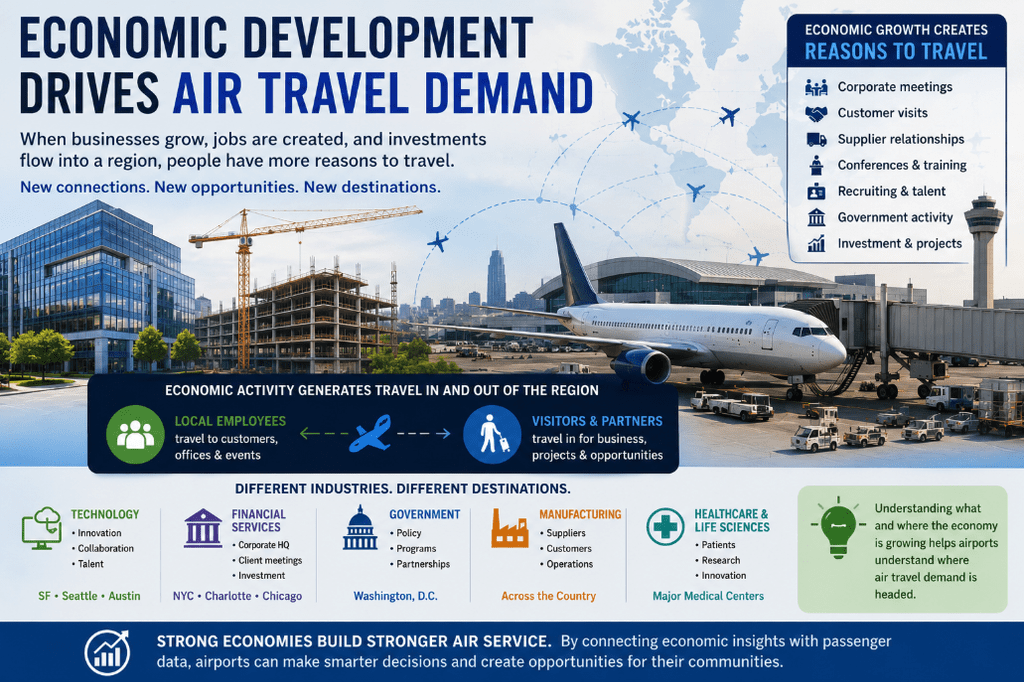
Economic development and air travel are closely connected. When a region attracts businesses, adds jobs, expands universities or hospitals, or lands a major investment project, it creates new relationships with other parts of the country and the world. Those relationships often generate travel.
For an airport Air Service Development team, however, knowing that the regional economy is growing is only the starting point. The more useful questions are: What is growing? Where is it growing? Which cities are those businesses and institutions connected to? And are those relationships showing up in passenger demand?
Employment Growth Can Create New Air Travel Demand
Job growth can increase passenger demand, but the number of new jobs tells only part of the story. Consider two regions that each add 10,000 jobs. One adds primarily locally oriented service employment. The other adds jobs in technology, consulting, biotechnology, finance, and corporate management. The aviation impact could be very different.
Industries with customers, suppliers, offices, investors, and business partners spread across multiple cities tend to generate more air travel. They can also create inbound demand as customers, consultants, executives, suppliers, and job candidates visit the region. That’s why airports should look at employment by industry, rather than total employment alone.
Different Industries Create Different Destination Relationships
Industry mix can also help explain where people travel. A growing technology sector may strengthen relationships with markets such as San Francisco, San Jose, Seattle, and Austin. Financial and professional-services employment may create stronger ties with New York, Charlotte, or Chicago. Federal government activity can contribute to Washington demand. Manufacturing can be more complicated. A plant may generate travel to its corporate headquarters, supplier locations, customer markets, engineering centers, and other production facilities.
These relationships become more useful for Air Service Development when they are compared with actual O&D data. If a region has a growing business relationship with Austin, for example, the airport can examine Austin passenger volume, growth, PDEW, fares, leakage, and existing air service. The economic story helps explain why the market exists and where it may be heading.
Major Investments Can Provide an Early Signal
Passenger data is backward-looking. A major economic development announcement may therefore matter well before its full impact appears in O&D data.
Toyota’s battery manufacturing plant in Liberty, North Carolina provides a real-world example. Toyota initially announced the plant in 2021 and subsequently expanded the project to a total investment of $13.9 billion and more than 5,000 jobs. The development created travel needs during construction and hiring, while the operating plant creates ongoing connections among Toyota employees, engineers, suppliers, executives, and other company facilities. For nearby airports, including GSO, RDU and CLT, a project of this scale can create new business travel relationships that may gradually become visible in O&D demand.
An announcement like this does not automatically justify a new route. But it gives the airport something worth watching. If passenger demand to the company’s headquarters or major supplier markets also begins increasing, the economic development story becomes much more relevant to an airline discussion.
Where the Jobs Are Located Matters
Economic growth is rarely distributed evenly across an airport’s catchment. One suburban corridor may attract technology companies while another develops a healthcare cluster. A downtown area may gain corporate offices. A university or hospital expansion may create another employment concentration altogether.
Mapping employees by ZIP code helps airports see where these changes are occurring and how they relate to airport choice. This is particularly important in competitive airport markets. A new employment center 25 minutes from the local airport and 70 minutes from a competing hub gives the local airport a meaningful convenience advantage, assuming it offers the routes and schedules travelers need.
A development near the boundary between two airport catchments creates a different situation. Thousands of new employees may have realistic access to both airports. In that case, nonstop service, schedules, corporate relationships, and airport awareness can influence where the new demand ultimately goes.
Some Economic Sectors Deserve Special Attention
Universities, healthcare systems, government operations, and military installations can create travel patterns that are easy to miss when looking only at population. A major university generates faculty and student travel, conferences, recruiting, athletics, research collaboration, and corporate partnerships. A medical center can attract physicians, researchers, pharmaceutical companies, medical-device firms, patients, and consultants. Government and military activity can create recurring demand to specific destinations. A federal employment concentration, for example, may have unusually strong ties to Washington. Military installations may generate travel to other bases and defense-related markets around the country. These institutions can explain why some markets generate much more air travel than their population would suggest.
Industry Clusters Can Matter More Than Individual Companies
Airports should also look beyond individual employers. A biotechnology cluster, for example, may include research institutions, pharmaceutical companies, specialized suppliers, venture capital firms, and dozens of smaller businesses. Together, they can create recurring travel relationships with other biotechnology centers. The same can happen with technology, finance, aerospace, manufacturing, or other industry clusters. For an airline, this can be a stronger story than relying on a single corporate announcement because the underlying demand comes from a broader economic base.
Economic Growth Can Change the Value of Passenger Demand
Economic development can affect passenger mix as well as passenger volume. Growth in corporate, technology, consulting, finance, and professional-services employment may contribute to more frequent business travel, higher fares, premium demand, and international travel. Higher incomes can also affect leisure demand. Households with more disposable income may travel more frequently, take more international trips, purchase premium products, or own second homes.
For an airline evaluating a market, 100 additional passengers are not necessarily economically equivalent to another 100 passengers. Understanding the type of economic growth behind the demand can help explain its potential revenue value.
Foreign Investment Can Strengthen International Markets
Foreign direct investment can be particularly relevant to international air service development. If a region attracts substantial investment from German, Japanese, Korean, or French companies, those investments can generate recurring travel by executives, engineers, technical teams, suppliers, and customers.
One foreign-owned company may not materially change an international route opportunity. A concentration of companies from the same country or region can be much more meaningful. If that investment is accompanied by growing O&D demand, premium traffic, and connecting passenger flows, it can strengthen the business case for international service.
Economic Development Can Also Explain Changes in Existing Markets
Economic information is useful for understanding changes already appearing in passenger data. Suppose demand to a particular city begins increasing even though air service has not changed significantly. A new corporate facility, supplier relationship, university partnership, or industry investment may help explain the increase.
The reverse can happen as well. A headquarters relocation, plant closure, major layoff, or reduction in government activity can weaken travel demand. Tracking major economic announcements alongside passenger trends gives airport teams additional context for understanding changes that may otherwise be difficult to explain.
Connect Economic Development with Actual Passenger Behavior
Economic development data becomes most useful when it is combined with aviation data. If a region has a growing technology relationship with Austin, for example, the airport should examine what is actually happening in the Austin market: passenger volume, growth, PDEW, average fare, nonstop versus connecting traffic, airport leakage, and premium demand. The strongest opportunities are those where economic evidence and passenger behavior reinforce each other.
Airports should be cautious about converting employment directly into passenger estimates. There is no reliable formula that says 1,000 new jobs will generate a certain number of airline passengers. Travel depends on the industry, job functions, company structure, supplier and customer networks, income, and available air service. Economic data should help explain passenger demand, not replace O&D analysis.
Economic Development and Airport Teams Can Help Each Other
Regional economic development organizations often know about business changes before they become visible in public data. They may know which companies are considering the region, which employers are expanding, where headquarters and suppliers are located, and which foreign companies are investing.
Airport teams bring a different set of information: O&D demand, fares, passenger leakage, airport usage, and potential route scenarios. Combining those perspectives can produce a much stronger picture of how regional economic growth may affect future air service.
The relationship also works in the other direction. Better air service can make a region more attractive to businesses that value nonstop access to headquarters, customers, suppliers, and international markets.
How Fligence ZIP-OD Helps
FlightBI’s Fligence ZIP-OD allows airports to examine economic geography alongside passenger behavior.
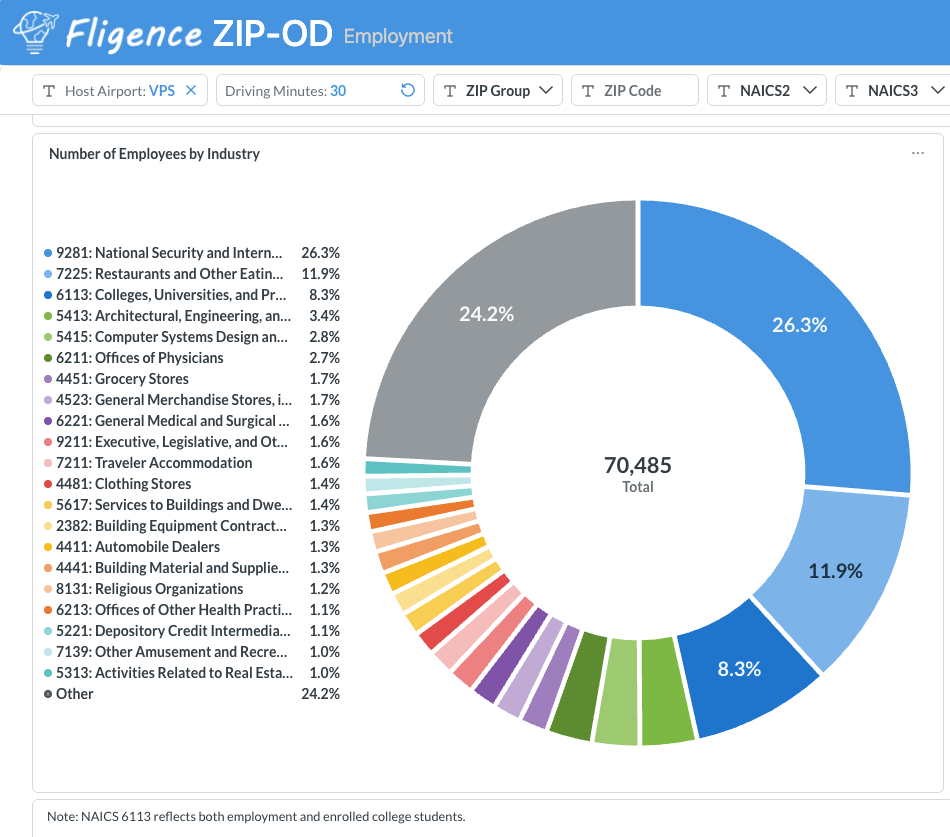
The platform provides employee counts by industry and ZIP code, including concentrations associated with universities, healthcare, government, and military activity. Airport teams can compare those employment patterns with passenger demand, destination demand, airport market share, leakage, and premium passenger demand.
For example, if a growing technology employment cluster appears in one part of the catchment, the airport can examine where residents and businesses in that area are traveling, which airports they use, and whether demand to major technology markets is increasing.
This connects: economic structure → passenger geography → destination demand and gives Air Service Development teams a better understanding of what may be driving changes in the market.
The Bottom Line
Economic development matters to airports because businesses and institutions create connections between regions, and those connections create reasons to travel. But job counts alone do not tell an airport how much passenger demand will develop. Industry mix, business relationships, employment location, income, airport access, and existing passenger behavior all matter. The most useful analysis combines economic development, employment by industry, passenger geography, O&D demand, and airport usage.
That allows an airport to move beyond asking, “How many jobs are being created?”
A more useful question is:
“What travel relationships are being created by this economic growth, and are we beginning to see them in passenger demand?”