
An airport’s passengers are not one uniform market. Some passengers live in the surrounding region and begin their trips there. Others live somewhere else and travel into the region for vacations, business, family visits, conventions, second homes, or other purposes.
These two groups can have very different geographic patterns, seasonality, airport preferences, and reasons for travel. Separating them helps airport Air Service Development and Marketing teams answer two different questions:
- Residents: Where do our local travelers live, where are they going, and which airports do they use?
- Visitors: Where are travelers coming from, and where do they stay or spend time after arriving?
For some airports, particularly tourism and resort airports, this distinction can completely change how the passenger market looks.
What Are Resident and Visitor Passengers?
A resident passenger lives within the airport’s broader market and travels to destinations outside the region. This could include a local family flying to Orlando, a business traveler heading to Chicago, or a resident visiting family in New York.
For these passengers, the airport is near the origin of the trip, so their geographic distribution tends to follow residential patterns.
A visitor passenger lives outside the region and travels into the airport’s market. Visitors can include:
- Tourists
- Business travelers
- Convention attendees
- People visiting friends and relatives
- Travelers visiting second homes
- University visitors
For these passengers, the airport is near the destination of the trip. Their local geography may therefore follow hotels, attractions, businesses, universities, second homes, or other places they visit rather than residential population.
Why the Difference Matters
Suppose a ZIP code generates 50,000 passenger trips. Without separating residents and visitors, that number tells the airport relatively little about what is creating the demand.
The ZIP code could be a large residential community whose residents travel frequently. It could contain a major resort district where most passengers are visitors. Or it could contain both.
Those situations have very different implications for:
- Air service development
- Airport marketing
- Tourism partnerships
- Catchment analysis
- Ground transportation
- Passenger forecasting
Understanding the passenger type helps explain why demand exists in a particular location, rather than simply showing where passenger activity occurs.
Resident Demand Usually Follows Where People Live
Resident passenger demand is generally associated with residential geography. Population is important, but several other factors influence how much air travel a community generates and which airport residents choose.
Airport teams can compare resident demand with:
- Population and household income
- Employment
- Drive time to the airport
- Access to competing airports
- Available nonstop service
- Fares and schedules
A large suburban ZIP code with high travel propensity may generate substantial resident demand even if it has few hotels, attractions, or major employers. This makes resident analysis particularly useful for understanding an airport’s local customer base and passenger leakage.
Visitor Demand Can Follow a Completely Different Map
Visitor geography often looks very different from residential geography. Visitors may concentrate around:
- Downtown and convention districts
- Beaches and resort areas
- Theme parks and attractions
- Hotels
- Universities
- Major employers
- National parks
- Second-home communities
A ZIP code with only a small permanent population could therefore be one of the airport’s largest passenger destinations.
Consider a coastal tourism airport. Resident demand might be concentrated in suburban and inland communities, while visitor demand follows a narrow beachfront corridor filled with hotels, vacation rentals, and second homes.
Looking only at total passenger activity blends these two markets together. Separating them shows what portion of demand comes from the local population and what portion is generated by people coming into the region.
Resident and Visitor Mix Varies by Airport
There is no standard resident-to-visitor ratio that applies to every airport.
A large metropolitan airport may depend heavily on local residents. A beach or mountain airport may have a much larger visitor component. A state capital can receive significant government and business travel, while a university market may experience large visitor flows around graduation, football weekends, parent weekends, and conferences.
Permanent population can therefore be misleading when comparing airport markets.
Consider two hypothetical regions:
| Philadelphia Market (PHL) | Las Vegas Market (LAS) | |
|---|---|---|
| 2025 resident trips by U.S. network carriers | 5.5 million | 3.0 million |
| 2025 visitor trips by U.S. network carriers | 2.1 million | 4.7 million |
As shown in Table 1, the Philadelphia (PHL) and Las Vegas (LAS) markets generated a similar number of trips on U.S. network carriers, including AA, DL, UA, AS, and HA, in 2025. However, their resident and visitor mix was very different. Residents accounted for 72.5% of PHL air trips, compared with only 38.9% of LAS air trips. Looking only at population would therefore substantially understate the effective travel market in a visitor-driven destination such as Las Vegas.
This is particularly important when an airport is presenting its market to an airline.
The Mix Can Also Change by Route
Resident and visitor shares can vary substantially within the same airport.
For example, Table 2 shows the resident-versus-visitor mix for three different markets from the Washington, D.C. area. About 98% of Cancun trips are made by D.C.-area residents, which makes sense given Cancun’s role as a major vacation destination. In contrast, about two-thirds of trips involving PSC are made by visitors to the Washington area, including business travelers visiting federal government agencies and tourists visiting the nation’s capital. Austin represents a more balanced market, with substantial travel in both directions. Washington-area residents travel to Austin, while Austin-area residents also have significant reasons to visit Washington.
| Market Type | Example | Resident Share | Visitor Share |
|---|---|---|---|
| Outbound Market | Cancun, Mexico (CUN) | 98% | 2% |
| Inbound Market | Pasco, WA (PSC) | 33% | 66% |
| Balanced Market | Austin, TX (AUS) | 50% | 50% |
These markets may require very different strategies. An outbound market is primarily supported by local-origin demand, so marketing may focus heavily within the airport’s catchment. An inbound market depends largely on inbound visitors, making destination marketing organizations, hotels, attractions, and airline partnerships more important. A balanced market may benefit from promotion at both ends.
For new route development, this also helps an airline understand which side of the market is supporting the proposed flight.
Resident and Visitor Airport Choice Can Differ
Residents know their local airport market well. They generally understand drive times, traffic, parking, airline options, and which competing airports are practical.
Visitors approach the decision from the other direction. They may choose an arrival airport based on airfare, nonstop availability, rental cars, or what appears in an online flight search.
A visitor may see a $50 cheaper fare into an airport 70 miles from the destination without fully understanding the additional drive time, traffic, tolls, or rental-car cost.
As a result, an airport can have a strong market share among local residents but lose substantial visitor traffic to a competing airport, or vice versa.
For tourism airports, this can create a specific marketing opportunity: help potential visitors understand which airport actually provides the easiest access to the destination they want to visit.
Resident and Visitor Marketing Should Target Different Places
The geographic direction of marketing changes depending on the passenger.
For resident marketing, the potential passenger already lives within the airport’s market. An airport can identify ZIP codes with high passenger demand, significant leakage, and relatively low local airport share, then target those communities with messages about nonstop service, convenience, parking, or avoiding the drive to a larger airport.
For visitor marketing, the potential passenger lives somewhere else. The airport instead needs to identify the outside markets that send visitors to its region.
Suppose a beach destination receives substantial visitor traffic from:
- New York
- Chicago
- Philadelphia
- Boston
Advertising to residents around the destination airport would do little to stimulate inbound tourism from those markets. The airport and its tourism partners can instead promote the destination and available air service in the cities where the visitors actually live.
This is one of the most important practical differences between resident and visitor analysis.
Visitor Analysis Creates Opportunities for Cooperative Marketing
Visitor demand also creates a natural connection between airports and local tourism organizations.
The interests of several groups can overlap:
- The airport wants more inbound passengers.
- The airline wants more bookings.
- The destination marketing organization wants more visitors.
- Hotels want more room nights.
- Attractions want more customers.
Data showing where visitors originate, where they stay, which airports they use, and which nonstop markets generate inbound demand can provide a common basis for cooperative marketing.
Instead of broadly advertising a destination, the partners can concentrate resources on origin markets with measurable visitor demand and relevant air service.
Hotels, Second Homes, and Businesses Help Explain Visitor Geography
Visitor demand is not driven by tourism alone.
Hotel concentrations can identify resort areas, convention districts, business centers, and other locations with substantial short-term visitation. A ZIP code with only 8,000 permanent residents but thousands of hotel rooms may generate far more airport activity than population would suggest.
Second-home owners create another pattern. They live elsewhere but may travel repeatedly to the same destination, stay for longer periods, and show strong seasonality. For resort airports, second-home travel can create recurring demand that resembles neither traditional resident travel nor occasional tourism.
Business visitors follow still another geography. Their destinations may include:
- Corporate headquarters
- Manufacturing facilities
- Hospitals
- Government agencies
- Universities
- Military installations
These locations can help explain inbound passenger activity in areas that would not stand out based on tourism or residential population.
Universities Can Generate Both Resident and Visitor Demand
University markets demonstrate why the distinction is not always simple.
Students may function as local residents during the academic year while maintaining permanent homes elsewhere. At the same time, universities attract visitors for graduation, athletics, parent weekends, campus visits, conferences, and research activities. A university ZIP code can therefore contain several different sources of passenger demand at the same time.
The objective is not to force every traveler into a perfect category. It is to understand enough about the passenger mix to explain what is driving air travel demand in the market.
Residents and Visitors Can Have Different Seasonality
The two groups may also peak at different times of the year.
A warm-weather destination, for example, may receive a large influx of northern visitors during winter while local residents generate more outbound travel during summer. A university airport may experience visitor peaks around graduation and major sporting events while student travel increases around academic breaks.
Major conventions, festivals, sporting events, and other temporary events can create additional spikes in visitor demand.
Separating residents and visitors makes these seasonal patterns easier to interpret and can help airports and airlines determine whether a market is better suited for year-round, seasonal, or event-related service.
Visitor Demand Can Strengthen an Airline Business Case
Visitor analysis is particularly important when permanent population understates the true size of an airport’s market.
Suppose an airport serves a region with only 500,000 permanent residents but receives several million visitors each year. Presenting the airline with resident population alone makes the market appear much smaller than the number of people actually generating travel to and from the region.
This is common for:
- Beach destinations
- Mountain resorts
- Theme-park markets
- Second-home destinations
- Major convention markets
For these airports, visitor demand can help explain why actual O&D traffic is much larger than demographic statistics alone would suggest.
The opposite can also occur. An airport with a large residential population but relatively few visitors may depend more heavily on outbound leisure travel, business travel, VFR demand, and passenger leakage recovery.
The airline business case should reflect the actual structure of the market rather than applying the same demographic story to every airport.
How Fligence ZIP-OD Separates Resident and Visitor Demand
FlightBI’s Fligence ZIP-OD allows airport teams to examine passenger geography using a Residents selector, making it possible to distinguish resident passenger patterns from the airport’s broader passenger distribution.
Airport teams can use this analysis to investigate questions such as:
- Where are resident passengers concentrated?
- How does resident geography differ from total passenger geography?
- Which areas appear to generate substantial visitor demand?
- Does airport market share differ between these passenger patterns?
These results can then be compared with passenger demand, drive time, household characteristics, hotels, second homes, and other geographic market information.
For visitor-oriented airports, hotel and second-home data can be particularly useful. They can help explain why certain areas generate substantial passenger activity even though their permanent populations are relatively small.
Build Separate Resident and Visitor Market Profiles
Rather than treating every passenger as part of the same market, airport teams can build two complementary profiles.
| Resident Market | Visitor Market |
|---|---|
| Where residents live | Where visitors stay or spend time |
| Where residents travel | Where visitors originate |
| Which airports residents use | Which airports visitors use to reach the region |
| Where resident leakage occurs | Which outside markets generate inbound demand |
| How demographics affect travel | How hotels, tourism, businesses, and second homes affect demand |
The two profiles can then be brought back together for route analysis. This gives airport teams a more complete picture of who generates demand on each side of a market and why.
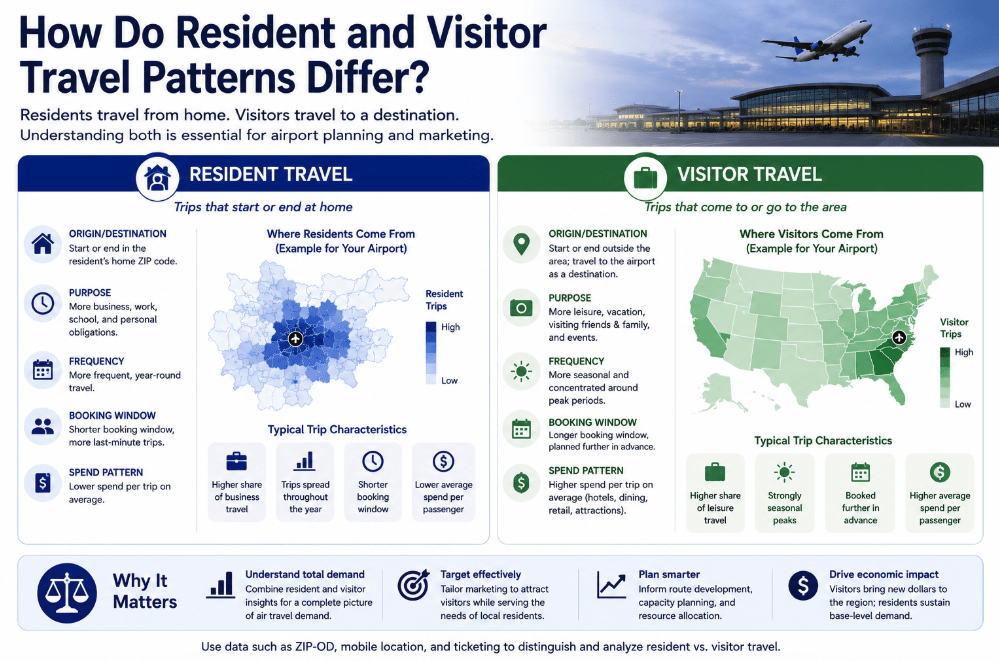
The Bottom Line
Resident passengers are primarily tied to where people live. Visitor passengers are tied to where people come from and why they travel to the region.
That difference affects passenger geography, seasonality, airport choice, marketing strategy, and the way an airport presents its market to airlines.
For Air Service Development teams, separating the two can show whether a route is supported primarily by local-origin demand, inbound demand, or a healthy balance of both. For Marketing teams, it determines whether campaigns should target communities within the airport’s catchment or potential visitors hundreds or thousands of miles away.
With Fligence ZIP-OD, airports can examine resident passenger geography separately from broader passenger patterns and combine that information with other geographic market data.
The important question is not simply “Where are our passengers?” It is “Which passengers live here, which passengers are coming here, and how should our air service and marketing strategies differ for each?”