
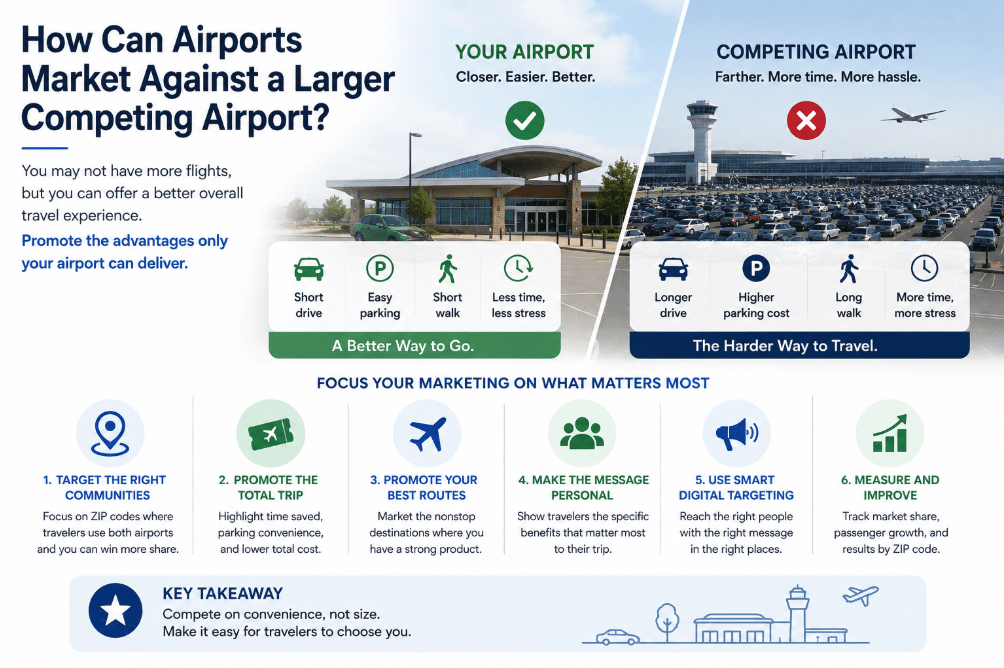
Smaller and regional airports often compete with larger airports that offer more airlines, destinations, and flight frequency. Matching a major hub on network size is difficult. Fortunately, passengers consider more than the number of flights on the departure board.
A local airport may offer a much easier trip through shorter drive times, simpler parking, less congestion, faster terminal access, and convenient nonstop service.
The marketing opportunity is strongest in communities where passengers can realistically use either airport. Airport teams can identify those markets, determine which trips the local airport can compete for, and give travelers a clear reason to reconsider their usual airport choice.
Compete on the Entire Trip
Passengers usually see airfare and flight schedules when they search for travel. Their actual journey begins at home.
Consider a traveler choosing between:
| Local Airport | Competing Hub |
|---|---|
| 30-minute drive | 90-minute drive |
| Easy parking | More expensive parking |
| Short terminal walk | Large terminal |
| Nonstop flight | Same nonstop destination |
If both airports offer a suitable nonstop, the local airport may provide the better overall experience even when the larger airport has more flights.
Marketing can draw attention to factors passengers sometimes overlook:
- Drive time and traffic
- Tolls and fuel
- Parking cost
- Time from parking to the gate
- Terminal convenience
- Total travel time
This type of positioning has been used by Rhode Island T. F. Green International Airport (PVD) in a market where Boston Logan is a major competitor. PVD has promoted the convenience of using Rhode Island’s airport rather than dealing with some of the additional travel associated with reaching and navigating Boston Logan.

For regional airports, the competitive advantage can begin well before the passenger reaches the terminal.
Build the Brand Around an Advantage the Larger Airport Cannot Easily Copy
A regional airport may have fewer destinations, but some of its strongest attributes come directly from being smaller.
These can include:
- Parking close to the terminal
- Shorter walking distances
- Faster curb-to-gate times
- Less congestion
- Easier highway access
- A simpler overall experience
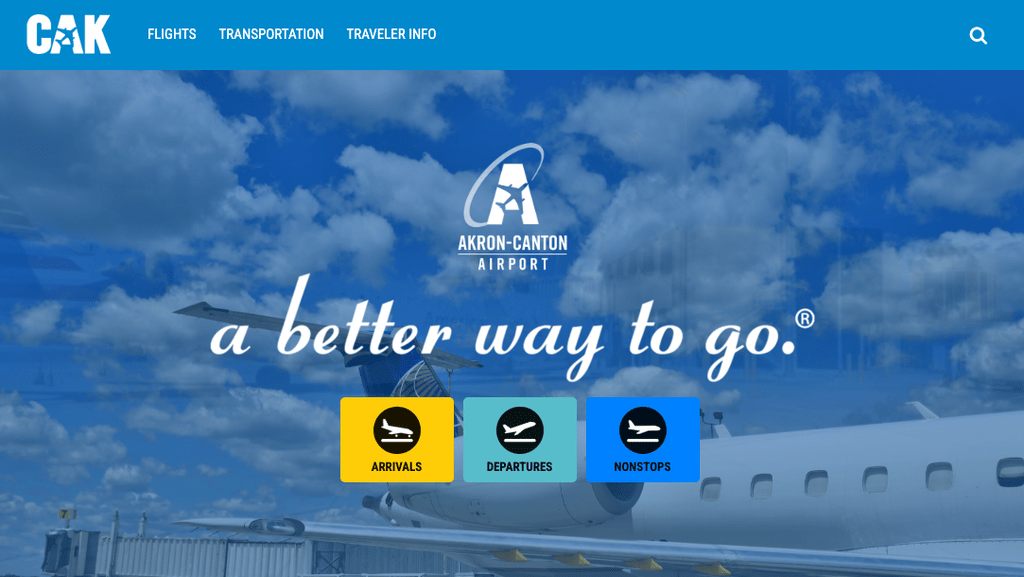
Akron-Canton Airport (CAK) is a good example. Competing in a region where passengers can also use Cleveland Hopkins, CAK has used “A Better Way to Go” as part of its positioning and emphasizes advantages such as parking closer, screening faster, and walking less.
Manchester-Boston Regional Airport (MHT) follows a similar strategy with “MHT Makes it Easy.” Its positioning makes simplicity part of the airport’s product.
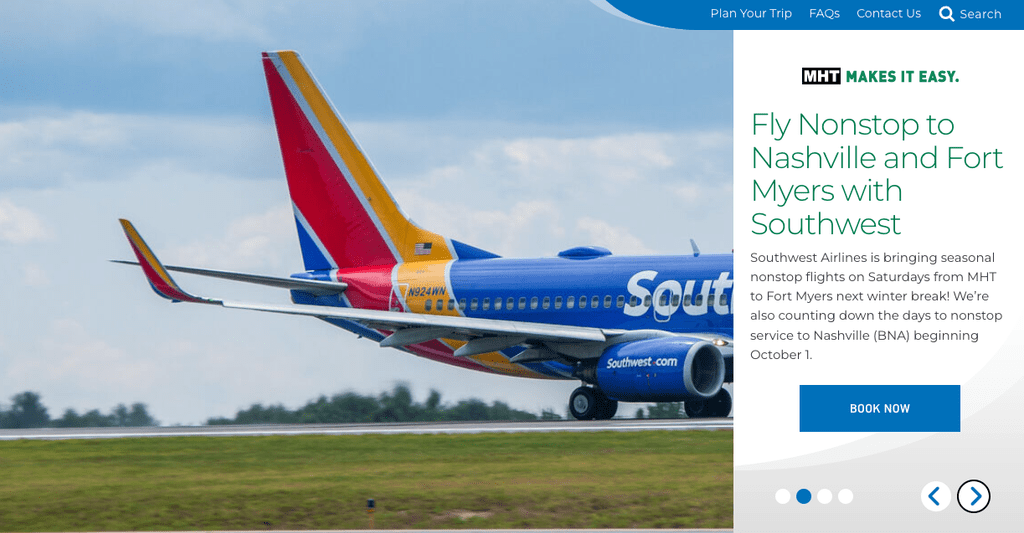
These messages work because they give passengers a specific reason to consider the smaller airport. The promise also extends beyond advertising. Parking, the website, flight search, wayfinding, and the terminal experience should reinforce the same idea.
Give Passengers a Reason Beyond “Fly Local”
“Fly local” can create community support, but it does not always explain what the passenger gains by changing airports.
A more useful message connects directly with the trip:
- “Skip the 90-minute drive and fly nonstop from your local airport.”
- “Start your trip closer to home.”
- “Compare the total cost of your trip.”
- “Your nonstop to New Orleans starts closer to home.”
Community pride can still support the campaign. Personal benefits such as time, convenience, and relevant nonstop service usually provide a stronger reason to change behavior.
Challenge Established Airport Habits
One of the biggest competitors for a regional airport may be habit.
Travelers often search the same airport every time they book because they have used it for years. They may assume the larger airport always has lower fares or that their local airport does not serve the destination they need.
Passenger perceptions can also lag behind changes in air service. An airport may have added several destinations while many residents still think, “My local airport doesn’t fly anywhere I need to go.”
This makes awareness an important part of competitive marketing. Campaigns can regularly communicate:
- New nonstop destinations
- New airlines
- Added frequencies
- Seasonal routes
- Schedule improvements
Sometimes the first behavioral change is simply getting travelers to check the local airport before booking.
Focus on the Geographic Battleground
The entire catchment does not have the same competitive potential.
Consider three groups:
| Market | Local Airport | Competing Airport | Likely Situation |
|---|---|---|---|
| Group A | 25 min | 90 min | Strong local-airport market |
| Group B | 50 min | 60 min | Competitive overlap |
| Group C | 100 min | 35 min | Strong competitor market |
Group A may already use the local airport heavily. Group C has a strong geographic reason to use the competitor.
Group B deserves special attention because both airports are practical choices. Marketing has a greater chance of influencing airport choice when neither airport has an overwhelming geographic advantage.
Passenger data can make this analysis more precise.
Suppose:
| ZIP Code | Total Air Demand | Local Airport Share | Competitor Share |
|---|---|---|---|
| ZIP A | 40,000 | 65% | 25% |
| ZIP B | 45,000 | 35% | 50% |
| ZIP C | 30,000 | 20% | 65% |
ZIP B could be particularly attractive. It generates substantial passenger demand, both airports already draw passengers from the community, and the local airport has considerable share available to win.
ZIP C has an even higher competitor share, but geography could explain it. If residents are much closer to the competing airport, additional advertising may have limited impact.
This is why passenger demand, airport share, and drive time should be evaluated together.
Compete Route by Route
A smaller airport does not need to compete with a hub for every passenger.
Suppose a major airport has 150 nonstop destinations and the regional airport has 25. For a passenger traveling to Orlando, the difference in network size matters much less if both airports offer a convenient Orlando nonstop.
The relevant comparison becomes:
Which airport gives me the better trip to Orlando?
This creates an important opportunity for regional airports. Competitive marketing can focus on specific routes where the local airport has a credible product.
Suppose one ZIP code generates 5,000 annual Orlando trips:
- 1,500 use the local airport
- 3,000 use the competing hub
- 500 use other airports
If both airports offer Orlando nonstop service, those 3,000 hub passengers deserve investigation.
Why are they choosing the larger airport? Possible explanations include fare, schedule, frequency, airline preference, habit, or lack of awareness. Some of these issues can be addressed through marketing. Others may require changes in air service.
Punta Gorda: Market the Flight You Can Win
Punta Gorda Airport (PGD) provides a useful example of route-focused competition.
PGD operates in Southwest Florida, where travelers have several airport choices. Its marketing has included digital campaigns promoting its individual nonstop destinations throughout the region, including destination-oriented messaging such as:
“A Short Drive South for a Nonstop Flight North.”
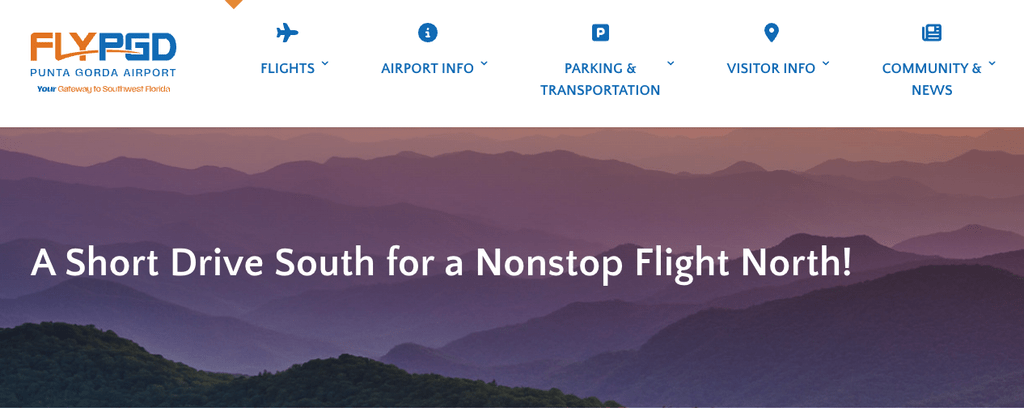
This approach connects three things:
geography + nonstop service + convenience
For a traveler whose destination is available nonstop from PGD, the airport has a specific product to sell. Marketing can concentrate on those passengers rather than trying to establish that PGD is the best airport for every possible trip.
That distinction is important for smaller airports. They do not need to win every passenger. They need to win more of the passengers for whom they have the right flight.
Help Passengers Compare the Total Cost
The larger airport may sometimes have a lower fare, but driving farther can add other costs.
Consider this example:
| Local Airport | Competing Airport | |
|---|---|---|
| Fare | $355 | $255 |
| Parking | $45 ($9 x 5) | $150 ($30 x 5) |
| Gas Cost | $2 | $13 |
| Fare + parking + driving | $402 | $418 |
The competing airport’s ticket is $100 cheaper, yet the trip costs $16 more after parking and fuel costs are considered.
A simple message such as “Compare the total trip” can encourage passengers to look beyond the first airfare displayed in a flight search. This is exactly what the Columbus Airport (CSG) is doing on their website.
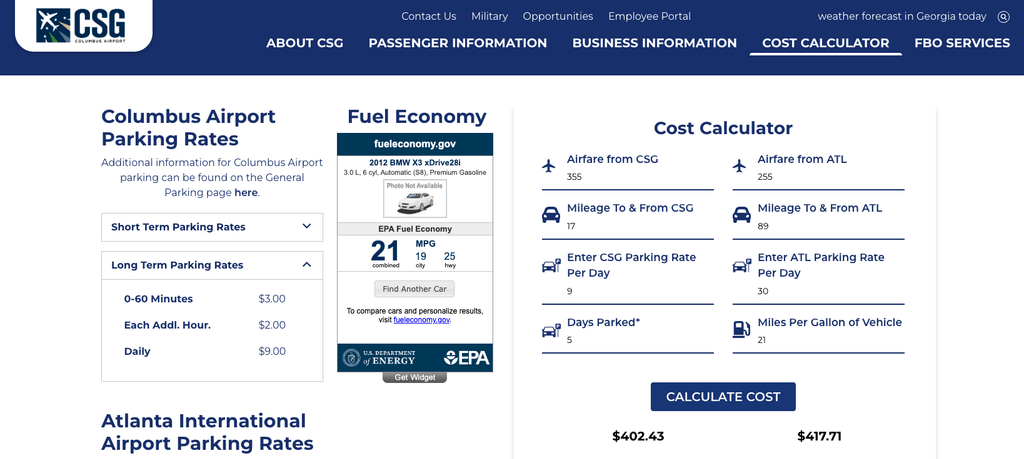
In fact, CSG’s total trip cost calculator does not account for the opportunity cost of the additional time spent driving to a more distant airport and navigating a larger terminal. If users could enter their own value of time per hour, the calculator could apply it to the difference in driving and airport navigation time. Including this cost would provide a more complete comparison of the total trip cost and could further highlight the value of using a smaller local airport.
Airports should be careful with broad fare claims because prices change constantly. “We’re cheaper than the hub” can quickly become inaccurate. Encouraging travelers to compare fares and total trip costs is more defensible.
Match the Message to the Community
Different parts of the catchment may require different messages.
A close-in community where residents routinely drive much farther to the hub might respond to “Why drive farther?”
In the competitive middle of the catchment, “Compare the total trip” may work better.
For a community with strong demand for a particular nonstop destination, the route itself should lead the campaign: “Your nonstop to New Orleans starts closer to home.”
Passenger characteristics can also influence the message. Business and premium travelers may place greater value on saving an hour of driving, avoiding congestion, or getting home earlier. Families may pay more attention to the combined effect of airfare, parking, drive time, luggage, and the length of the travel day.
The airport can therefore combine geographic targeting with route and passenger-specific messaging.
Work with Air Service Development
Marketing works best when the airport has a product passengers can realistically choose.
If the larger airport offers ten daily nonstops to a destination and the local airport has no nonstop service, advertising alone is unlikely to shift much traffic.
The picture changes when the local airport has:
- Nonstop service
- Competitive fares
- Useful departure times
- Reasonable frequency
- A substantial ground-access advantage
Marketing and Air Service Development should therefore examine competitive markets together.
If the local airport has a good flight but weak passenger share, awareness may be the problem. If the service itself is much less competitive, ASD may need to address the product before additional advertising can have much effect.
Use Digital Advertising Where Competition Is Happening
Once the airport identifies its competitive markets, digital advertising can concentrate on ZIP codes where:
- Passenger demand is substantial
- The competing airport captures meaningful traffic
- The local airport remains geographically practical
- Relevant local service exists
Route-specific targeting can narrow the audience further.
For example, if the local airport and the hub both serve New Orleans, the airport can identify ZIP codes generating substantial New Orleans demand where many passengers currently use the hub. Those ZIP codes become priority markets for New Orleans advertising.
Search advertising can reach passengers already planning a trip, while social, display, and video campaigns can build awareness of the local option.
Measure Whether Passenger Behavior Changes
Clicks, impressions, and video views are useful for managing digital campaigns, but airport passenger data can answer the larger question: Did travelers actually change airports?
Airport teams can monitor:
- Passenger volume from targeted ZIP codes
- Local airport share by ZIP code
- Destination-specific airport share
- Competing-airport usage
- Route PDEW
Suppose a targeted ZIP cluster begins with a 35% local airport share. After sustained marketing, share increases to 43%.
Destination-level analysis can provide an even clearer signal. If New Orleans share in the targeted ZIP codes increases from 25% to 45% following a New Orleans campaign, the airport has evidence that its competitive position changed in the market being promoted.
This type of analysis connects marketing activity with actual passenger behavior.
How Fligence Supports Competitive Airport Marketing
FlightBI’s Fligence ZIP-OD helps airport teams identify where their passenger market overlaps with larger competing airports.
Marketing teams can analyze:
- Total passenger demand by ZIP code
- Local airport market share
- Competing-airport usage
- Passenger leakage
- Destination-specific demand
- Drive time
- Household income
- Premium passenger demand
This makes it possible to find communities where a competing airport carries substantial passenger volume while the local airport remains a practical alternative.
The analysis can then move to individual routes. If both airports serve a destination nonstop, Fligence can identify where passengers using the competing airport live and how much demand those communities generate.
The Fligence Fare Comparison Dashboard adds fare information to the analysis. Airport teams can compare average fares for major destinations with weighted average fares from competing airports and evaluate those results alongside passenger demand and PDEW.
Together, these tools can help determine whether weak airport share points primarily to a marketing opportunity or an air service issue.
What Regional Airport Marketing Has in Common
PVD, CAK, MHT, and PGD use different messages because they operate in different markets. Their strategies share a common theme:
| Airport | Competitive Position |
|---|---|
| PVD | Easier alternative for parts of the Boston-area market |
| CAK | Simpler airport experience through “A Better Way to Go” |
| MHT | Convenience and simplicity through “MHT Makes it Easy” |
| PGD | Specific nonstop opportunities for regional travelers |
| CSG | Lower total trip cost |
Each airport focuses attention on an advantage it can credibly offer.
That is a more sustainable competitive position than trying to match a major hub’s size.
A Practical Competitive Marketing Process
Airport Marketing teams can use a straightforward process:
- Map the competitive overlap. Find communities where both airports attract meaningful passenger traffic.
- Measure the opportunity. Focus on areas with substantial demand and enough local airport accessibility to make switching realistic.
- Check the flight product. Identify destinations where the local airport has competitive service.
- Understand why passengers leave. Examine fares, schedules, frequency, airline preference, drive time, and awareness.
- Define the local advantage. Determine whether the strongest message is convenience, time, total cost, nonstop service, or another benefit.
- Target by geography and destination. Concentrate marketing where the local airport has passengers it can realistically win.
- Measure passenger behavior. Track ZIP-level and route-level airport share and adjust the campaign as the market changes.
The Bottom Line
A regional airport does not need to match a larger competing airport’s network to compete effectively for passengers.
The strongest opportunities are usually found where passenger demand is substantial, both airports are realistic choices, the local airport offers relevant service, and the local option provides a meaningful advantage in convenience, time, total cost, or nonstop access.
Real-world examples show several ways to communicate that advantage. PVD emphasizes an easier alternative for travelers who might otherwise use Boston. CAK and MHT make simplicity central to their positioning. PGD promotes specific nonstop opportunities across its regional market. And CSG helps travelers focus on total trip cost.
For airport Marketing teams, the most useful question is:
“Where does our airport offer a better trip, and which passengers need to hear about it?”