
Launching a new nonstop route creates an opportunity, but passengers still need to know the flight exists and have a reason to change how they travel.
A good route campaign starts with the people most likely to use the service. Airport Marketing teams should understand who already travels to the destination, where those travelers live, which airports they use today, and what the new nonstop improves for them.
For some passengers, the benefit may be eliminating a connection. For others, it may mean avoiding a long drive to a competing airport. The campaign should make that benefit clear while concentrating marketing resources in the geographic markets with the strongest passenger opportunity.
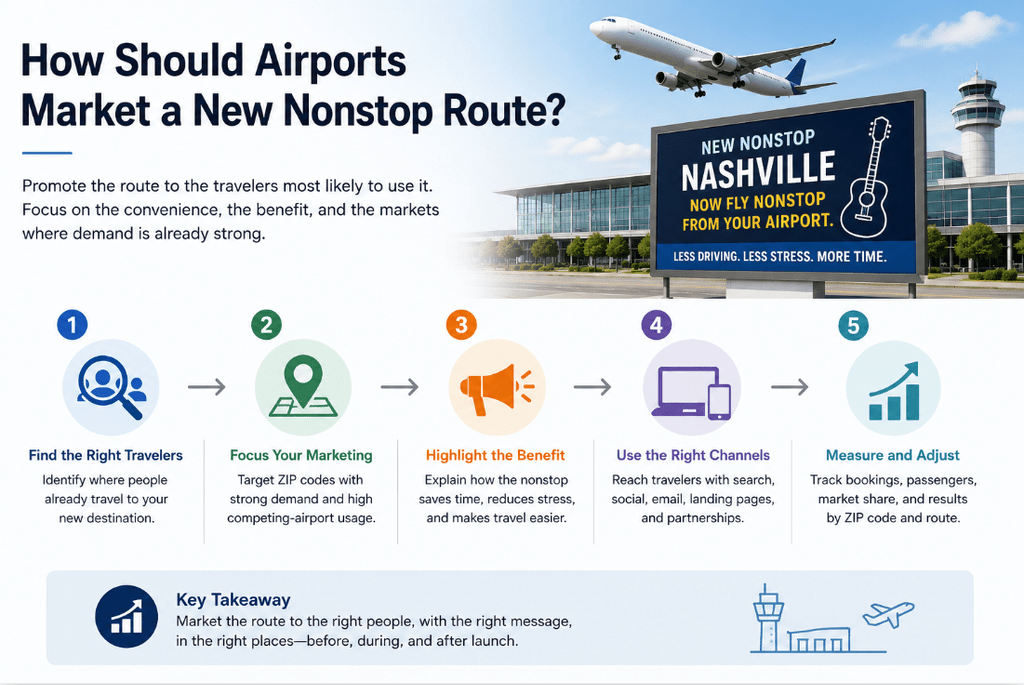
Start Marketing Before the First Flight
Marketing should begin when the route is announced and available for booking. The weeks or months before launch give passengers time to discover the service, compare schedules and fares, and incorporate the new flight into future travel plans.
A route campaign generally moves through four stages:
- Announcement: Introduce the route, airline, start date, and booking availability.
- Pre-launch: Build awareness and encourage advance bookings.
- Launch: Use the inaugural flight, media coverage, and community events to create visibility.
- Post-launch: Continue supporting the route while passenger awareness and travel habits develop.
The inaugural event can generate useful publicity, but the route needs sustained demand long after the ribbon cutting.
Start with Existing Destination Demand
One of the best audiences for a new nonstop is people who already travel to the destination.
Suppose an airport is launching nonstop service to Nashville:
| ZIP Code | Annual Nashville Demand |
|---|---|
| ZIP A | 4,500 |
| ZIP B | 3,800 |
| ZIP C | 2,600 |
| ZIP D | 1,900 |
These travelers have already demonstrated demand for Nashville. The campaign can focus on the new travel option:
“You can now fly nonstop to Nashville from your local airport.”
This is more focused than promoting Nashville equally across the airport’s entire catchment.
Overall air travel demand can also be misleading for a route campaign. A ZIP code generating 50,000 annual air trips may produce only 1,200 Nashville trips, while another ZIP code with 28,000 total trips generates 3,600 Nashville trips. For the Nashville campaign, the second ZIP code is more relevant.
This makes ZIP code + destination a useful level of analysis for new-route marketing.
Find Passengers Currently Using Competing Airports
The next question is where those passengers begin their trips today.
Suppose ZIP A generates 4,500 annual Nashville trips:
- 900 use the local airport
- 3,600 use competing airports
That creates a clear passenger opportunity if the new local nonstop is competitive.
The airport can identify similar ZIP codes throughout its market and determine where the largest concentrations of destination passengers are currently leaving for another airport.
Drive time also matters. A ZIP code with 5,000 Nashville trips may look attractive, but its residents may live 25 minutes from a competing airport and 90 minutes from the local airport. Another ZIP code with 3,500 trips and a strong local drive-time advantage could offer a better marketing opportunity.
The strongest geographic targets generally combine:
- Significant destination demand
- High competing-airport usage
- Reasonable access to the local airport
- A meaningful improvement from the new service
This gives the Marketing team a practical geographic audience before the first flight operates.
Give Passengers a Specific Reason to Switch
“New nonstop service” is useful information, but the campaign becomes stronger when it explains what the new flight changes for the passenger.
Depending on the market, the new route may offer:
- No connection
- Shorter total travel time
- A shorter drive to the airport
- Better departure times
- Lower total trip cost
- Easier family travel
- More convenient business travel
The right message depends on what passengers currently do.
If many Nashville passengers drive 90 minutes to a large hub, a useful message might be:
“Skip the long drive. Nashville now flies nonstop from your local airport.”
If passengers already use the local airport but connect to Nashville:
“No more connection. Nashville is now nonstop.”
For a business-heavy market:
“Save time with nonstop service to Nashville.”
The flight is the same in each case. The passenger benefit changes with the market.
Promote the Complete Travel Experience
Airfare is important, but passengers also spend money and time getting to the airport.
A competing airport may involve:
- A longer drive
- Tolls
- More fuel
- Higher parking costs
- More traffic
- Additional travel time
Suppose the local airport is 25 minutes away and the competing hub is 90 minutes away. Even if the competing airport has a somewhat lower fare, the local nonstop may still provide a better overall trip.
This can be particularly effective in communities where passengers routinely drive long distances to larger airports.
Airport campaigns can communicate total travel time, parking convenience, airport accessibility, and nonstop service together rather than relying only on airfare.
Use Different Channels for Different Jobs
A route campaign usually needs a mix of digital channels.
Search advertising can reach people who are actively planning a trip. Relevant searches might include “flights from [local city] to Nashville,” “nonstop flights to Nashville,” or similar destination-specific searches.
Display, video, and social media can build awareness among potential passengers who are not currently searching for a flight. These campaigns can be geographically concentrated in ZIP codes with strong Nashville demand.
Email and airport-owned channels can reach existing airport customers who may already be familiar with the convenience of using the airport.
A dedicated route landing page can bring these channels together. It should make important information easy to find, including the airline, launch date, days of operation, schedule, booking link, and airport convenience.
For leisure routes, destination content can also stimulate incremental demand. Weekend itineraries, events, restaurants, beaches, outdoor activities, sports, and seasonal attractions can give travelers another reason to consider the trip.
Be Clear About Frequency and Schedule
A passenger who sees “New nonstop to Nashville” still needs to know whether the flight works for the trip being planned.
Marketing materials should clearly communicate relevant operating details, especially for less-than-daily or seasonal service:
- Days of operation
- Frequency
- Departure times
- Seasonal start and end dates
For example:
“Fly nonstop to Nashville every Monday, Wednesday, Friday, and Sunday.”
Making the schedule clear reduces the work required for passengers to determine whether the new service fits their plans.
Coordinate with the Airline
Airport and airline marketing should reinforce each other.
The airport usually has strong knowledge of the local market, including where passengers live, which communities use competing airports, and which local organizations can help promote the service.
The airline brings its own capabilities, including booking data, loyalty channels, customer databases, digital marketing, fare promotions, and brand reach.
Coordination can cover:
- Campaign timing and creative
- Geographic targeting
- Fare promotions
- Paid digital media
- Email and social campaigns
- Public relations
- Corporate sales
- Community outreach
When airline co-op or launch funds are available, passenger data can also help show why certain ZIP codes deserve more investment than others.
Use Local Partnerships Where They Fit the Route
Some routes have clear business, tourism, or community relationships that can strengthen the campaign.
For a business-oriented route, airport teams can work with major employers, chambers of commerce, economic development organizations, and companies with offices in both markets. Direct outreach can communicate a very specific benefit:
“Your employees can now travel nonstop between our region and Nashville.”
Tourism routes create opportunities to work with destination marketing organizations, hotels, attractions, and convention and visitors bureaus. Marketing may need to occur at both ends of the route when inbound visitors are an important part of the demand.
Routes with strong visiting-friends-and-relatives traffic may benefit from outreach through community organizations, cultural associations, local media, and businesses serving those communities.
These partnerships are most useful when they reflect the actual passenger base behind the route.
Support the Route After Launch
Passenger behavior rarely changes immediately after a new route begins.
Someone may see an advertisement today but have no reason to visit Nashville for another four months. Another traveler may continue using the competing airport simply because that is what they have done for years.
Marketing should therefore continue through the route’s early development period.
The emphasis can change over time. Early campaigns may focus on awareness. Later campaigns can emphasize booking, specific travel periods, fare promotions, or markets where passenger adoption is weaker than expected.
This is especially important when the route depends on changing established airport-choice habits.
Use Post-Launch Passenger Data to Adjust the Campaign
Once the route begins operating, the airport can compare actual passenger behavior with the opportunity identified before launch.
Suppose a target ZIP code generated 4,000 annual destination trips and the local airport previously captured only 15%. After the nonstop launches, airport share rises to 45%.
That change provides useful evidence that the new service is gaining traction in the target market.
The Marketing team can also examine:
- Which ZIP codes generate passengers on the new route
- Which target markets are performing below expectations
- Whether passengers are shifting from competing airports
- Whether total destination demand is growing
- How local airport share changes over time
If a high-demand ZIP cluster remains weak, additional advertising may be appropriate. If another target area is already performing strongly, some of that spending can be shifted elsewhere.
This creates a feedback loop between passenger analysis and marketing decisions.
Understand Whether the Route Is Capturing or Creating Demand
Traffic growth after a new nonstop can come from several sources.
Some passengers may switch from competing airports. Others may have previously taken connecting flights from the local airport. The improved service can also stimulate new trips that would not otherwise have occurred.
Understanding the mix helps the airport explain what the new service is accomplishing.
A route that primarily captures passengers from competing airports is improving the airport’s share of an existing market. A route that also increases total destination traffic demonstrates demand stimulation.
Both can contribute to route success, and they may call for different marketing strategies as the service matures.
How Fligence Supports New Route Marketing
FlightBI’s Fligence ZIP-OD can help airport Marketing teams identify the geographic passenger opportunity behind a new route.
Before launch, teams can analyze:
- Destination-specific passenger demand by ZIP code
- Passengers currently using competing airports
- Airport market share
- Resident passenger locations
- Drive times
- Household income
- Premium passenger demand
This allows the airport to identify where travelers to the new destination are concentrated and which areas offer the strongest opportunity to shift passengers to the new service.
After launch, the geographic analysis can be repeated using actual passenger behavior. Additionally, the Time Series dashboard can be used to see where the route is gaining share and where additional support may be needed.
A Practical New Route Marketing Plan
A new-route campaign can follow a straightforward process:
- Understand the market. Measure existing and potential demand for the destination.
- Locate the passengers. Identify the ZIP codes generating the most relevant traffic.
- Understand current airport choice. Determine where those passengers fly from today.
- Prioritize addressable markets. Consider passenger volume, competing-airport usage, drive time, and the improvement created by the new flight.
- Define the message. Explain the specific benefit the nonstop provides.
- Coordinate the campaign. Align airport, airline, business, tourism, and community marketing where appropriate.
- Build awareness before launch. Give passengers time to discover and book the service.
- Continue after launch. Support the route while passenger habits develop.
- Measure passenger behavior. Track route traffic, ZIP-level origins, and destination market share.
- Adjust the campaign. Direct future spending toward markets where additional passenger opportunity remains.
The Bottom Line
Successful new-route marketing begins with the passenger market behind the flight.
Airport teams can identify who already travels to the destination, where those passengers live, which airports they currently use, and what the new nonstop improves about their trip. That information provides a strong foundation for geographic targeting and campaign messaging.
Marketing should begin before the first flight and continue after launch. As actual passenger behavior becomes available, the airport can refine its geographic targets and concentrate resources where additional opportunity remains.
For a new nonstop, the most useful marketing question is:
“Which travelers are most likely to use this route, and what will give them a reason to choose the new flight?”