
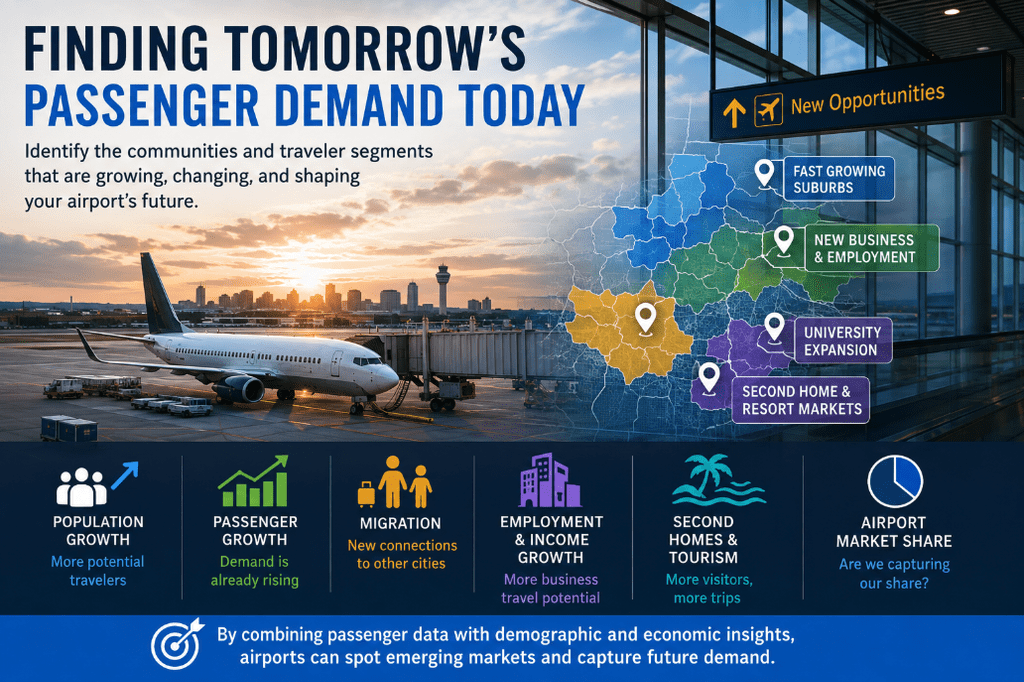
Airport passenger markets are constantly changing. A community that generates relatively little air travel today could become an important part of an airport’s market five years from now. Population growth, migration, rising incomes, new businesses, university expansion, second-home development, and changing travel behavior can all contribute to that change.
The challenge for Air Service Development and Marketing teams is identifying these markets early. Historical passenger data is very good at showing where demand already exists. Finding emerging demand requires looking at what is changing underneath those passenger numbers.
Start with Passenger Growth, but Look Beyond the Largest Markets
Ranking ZIP codes or counties by passenger volume tells an airport where its largest markets are today. It does not necessarily show where the next major source of growth will come from.
Consider two ZIP codes. One generates 90,000 passenger trips a year but has grown only slightly over the past five years. Another generates 25,000 trips but generated only 12,000 five years ago. The first remains more important in absolute terms. The second may be more interesting from a growth perspective. This is why airports should look at market size and market trajectory together.
Sustained passenger growth is usually the best place to start. Once an area stands out, the next question is what is causing it.
Compare Passenger Growth with Population Growth
Population is one of the most obvious explanations for increasing passenger demand. More residents generally mean more potential travelers. But passenger demand does not always move at the same rate as population.
In the following example, Wake County, NC grows 13.0% in population and 15% in passenger demand. Most of the additional air travel could reasonably be associated with the expanding population base. By contrast, Durham County, NC grows only 7.5% in population while passenger demand increases 21.4%. Something else appears to be happening. Residents may be traveling more frequently. Household incomes may be increasing. The employment base may be changing. New residents may have different travel patterns from the people they replaced. New business or destination relationships may also be developing.
| County | 2019 Population | 2025 Population | Population Growth 2019–2025 | 2019 Resident Air Trips | 2025 resident Air Trips | Air Trip Growth 2019-2025 |
|---|---|---|---|---|---|---|
| Wake County, NC | 1,112,795 | 1,257,235 | +13.0% | 3,708,198 | 4,263,652 | +15.0% |
| Durham County, NC | 322,969 | 347,240 | +7.5% | 743,660 | 903,049 | +21.4 |
Source: U.S. Census Bureau, Fligence ZIP-OD
The difference between population growth and passenger growth can therefore be one of the first clues that a market deserves a closer look. Air travel propensity is particularly useful here. If passenger trips per resident are increasing, the community can become a much more important aviation market even without exceptional population growth.
Look at Who Is Moving Into the Market
Population growth tells you how much an area is growing. Migration can help explain where that growth is coming from. This matters because people do not necessarily leave their previous relationships behind when they move. A region receiving significant migration from New York, Chicago or South Florida may develop stronger travel relationships with those markets. New residents may still have family, friends, business relationships, property, or professional connections in their previous communities.
Migration becomes much more interesting when the aviation data begins moving in the same direction. If migration from South Florida is increasing and Miami/Fort Lauderdale O&D demand is also growing, there may be a strengthening relationship between the two regions. If that market also has high fares, significant leakage, or limited nonstop service, it deserves deeper analysis.
Migration alone does not establish a route opportunity. It helps explain why an existing O&D market may be changing.
Income and Employment Can Change How Much People Travel
Some emerging markets are not experiencing extraordinary population growth at all. Their economic characteristics are changing. A community may add higher-income households, professional employment, corporate offices, technology firms, healthcare facilities, or other businesses that generate frequent travel.
Median household income can provide a starting point, but the distribution of households is often more informative. A modest increase in median income can hide a large increase in households earning $150,000 or $200,000 or more.
Employment should be viewed similarly. Adding 5,000 jobs in a locally oriented industry such as restaurant may have a very different aviation impact from adding 5,000 technology, consulting, finance, scientific research, or corporate-management positions. For airport analysis, the questions are what kinds of jobs are being created and where they are located. A new employment corridor can gradually shift the geographic distribution of passenger demand across the catchment. If that corridor is also near a competing airport, its development can affect airport market share as well as total demand.
Universities, Healthcare, Government and Military Can Create Their Own Growth Patterns
Certain institutions can create significant travel demand that is difficult to explain from population statistics alone.
A growing university can generate student and parent travel, faculty travel, recruiting, research collaboration, conferences, athletics, and other trips. A medical center can attract physicians, researchers, patients, pharmaceutical companies, medical-device firms, and consultants. Government and military installations can create recurring official, contractor, training, family, and relocation travel.
These markets may also have very specific destination relationships. A university may develop stronger connections with other academic and research centers. A military installation may generate significant demand to other bases. A federal employment center may have unusually strong demand to Washington. Looking at the underlying institution can help explain O&D patterns that otherwise appear unusual.
Second Homes Can Create Growth That Population Data Misses
Second-home markets present a different challenge. A coastal, mountain, or resort community might show very little permanent population growth while adding hundreds or thousands of second homes. Those owners are not counted as permanent residents of the destination, but they have a recurring reason to travel there.
For aviation analysis, the important question is where those owners live. If a growing resort community has large concentrations of second-home owners from New York, Washington, Chicago, or Boston, those relationships may create seasonal passenger demand between the two markets. Comparing second-home ownership with actual O&D trends can show whether that demand is already developing.
Don’t Forget Visitor Growth
Emerging demand does not have to come from local residents. A region may attract more tourists, convention attendees, business visitors, sporting-event traffic, or resort visitors even when its population barely changes. That is why resident and visitor demand should be separated whenever possible.
A growing resident market and a growing visitor market may produce the same increase in airport passengers, but they have very different causes and may require very different air service and marketing strategies.
Look at Where Demand Is Growing
Total passenger growth can also hide important destination-level changes. A county’s total air travel may increase only modestly while demand to one destination grows rapidly. That could reflect migration, a new business relationship, family connections, tourism, or another change occurring between the two regions.
Airport teams should therefore look at both where passengers are coming from within the catchment and where they are traveling. A developing destination relationship can sometimes become visible before the broader geographic market appears remarkable.
Emerging Demand May Show Up as Leakage First
One of the most important points for smaller and mid-sized airports is that growing demand may not initially appear in the airport’s own passenger statistics. A fast-growing suburb could add thousands of residents and generate substantially more air travel, while the local airport captures only 30% of those passengers. Most of the new demand would appear as leakage to competing airports.
From the local airport’s perspective, enplanements might show only modest growth. Catchment-level data tells a different story. This makes growing passenger demand combined with low airport market share one of the most useful signals for airport Marketing teams.
If the airport already offers competitive service, the area may represent a passenger acquisition opportunity. If passengers are leaking because the necessary service does not exist, the same growth may support an Air Service Development opportunity.
Growth and Airport Share Should Be Viewed Together
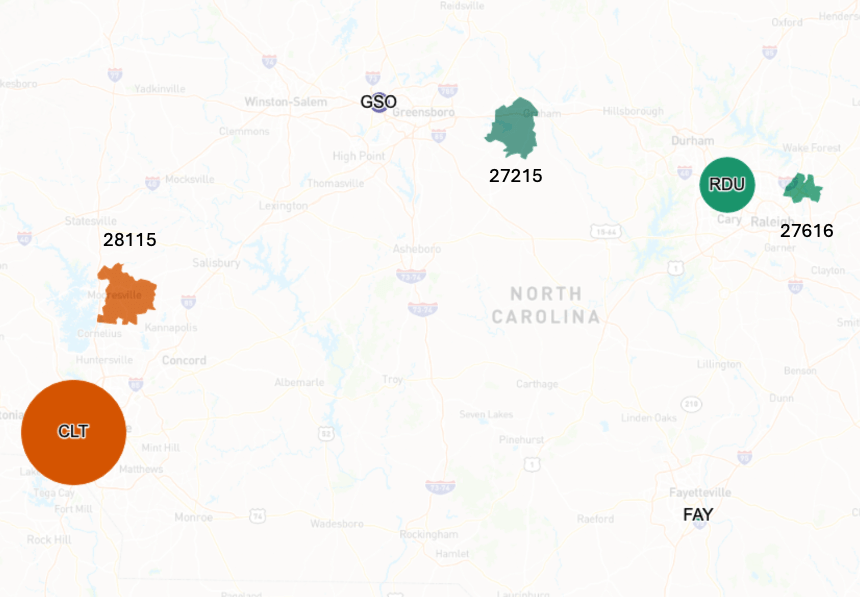
Consider the following three ZIP codes that have all experienced strong population and air travel growth.
| ZIP code | 2019 Population | 2024 Population | Population Growth | 2019 Resident Air Trips | 2025 Resident Air Trips | Air Trip Growth | RDU Airport Share |
|---|---|---|---|---|---|---|---|
| 27616 Raleigh, NC | 55,128 | 63,520 | +15.2% | 177,462 | 236,723 | 33.4% | 97.7% |
| 27215 Burlington, NC | 42,331 | 47,102 | +11.3% | 56,303 | 78,394 | 39.2% | 72.3% |
| 28115 Mooresville, NC | 37,673 | 43,544 | +15.6% | 85,719 | 117,209 | 36.7% | 0.4% |
Source: U.S. Census Bureau, Fligence ZIP-OD
ZIP 27616 generates the most passenger demand, but the local airport RDU already captures almost all of it. There is little remaining traffic to recapture. ZIP 28115 is growing quickly but sits much closer to a competing hub CLT. Geography makes a substantial increase in local-airport share difficult. ZIP 27215 is growing quickly, already generates substantial passenger demand, and still has meaningful leakage to competing airports.
That third market may deserve the most immediate attention. If it continues growing, today’s leakage problem could become much larger. Improving airport share now would also allow the airport to capture more of the growth as the community expands. This is why growth should be considered alongside market share rather than analyzed separately.
Look for Several Signals Moving Together
There is no single metric that identifies an emerging passenger market. A practical analysis can bring together several measures:
| Indicator | What to Look For |
|---|---|
| Passenger growth | Is air travel already increasing? |
| Population growth | Is the potential traveler base expanding? |
| Passenger growth vs. population | Are residents beginning to travel more frequently? |
| Migration | Are new geographic relationships developing? |
| Income | Is the number of higher-income households increasing? |
| Employment | Are travel-intensive industries expanding? |
| Second homes | Is recurring nonresident demand developing? |
| Destination trends | Are particular city-pair relationships strengthening? |
| Airport market share | Is the local airport capturing the growth? |
The most interesting markets are usually those where several indicators tell the same story. For example, a suburb with fast population growth, rising income, increasing passenger demand, and only 40% local-airport share is more interesting than its population growth alone would suggest. It has an expanding traveler base, evidence that those residents are actually flying, and substantial demand still available for the airport to capture.
Separate Structural Growth from Temporary Spikes
Not every increase represents an emerging market. Special events, temporary construction projects, airfare promotions, unusual capacity changes, or other short-term factors can produce temporary increases in passenger volume.
Multi-year trends provide a better foundation. If passenger growth persists for several years and is accompanied by population growth, migration, higher income, employment expansion, or second-home development, there is stronger evidence that the market is changing structurally.
This is especially important when presenting an emerging opportunity to an airline. The objective is to demonstrate that the underlying conditions supporting the demand are likely to continue.
Find Emerging Markets Before They Become Obvious
The value of emerging-demand analysis is timing. Once a fast-growing community becomes one of an airport’s largest passenger sources, it is no longer difficult to identify. The opportunity is finding it earlier.
For Air Service Development, that can mean identifying growing O&D markets, new VFR relationships, changing business connections, seasonal opportunities, or markets where leakage is likely to increase.
For Marketing, it can mean reaching new residents, fast-growing suburbs, high-income communities, and developing leakage markets before travel habits become firmly established around a competing airport.
Early identification gives the airport time to understand the market, track relevant destinations, build airline business cases, work with community partners, and improve awareness.
How Fligence ZIP-OD Helps
FlightBI’s Fligence ZIP-OD brings passenger behavior and geographic market characteristics together.
Airport teams can examine ZIP-level passenger demand alongside population, household income, households by income range, employee counts by industry, university students, hospital employees, government and military populations, resident and visitor demand, air travel propensity, airport market share, and leakage.
The Migration Dashboard adds county-level IRS migration patterns, including where residents are moving from and the airports used between the source and destination markets.
The Second Home Dashboard provides another view of demand by connecting second-home locations with owners’ primary residences, property values, drive times, and relevant airports.
These datasets allow airports to investigate a market from several directions rather than relying on a single growth measure.
The Bottom Line
Emerging passenger demand rarely announces itself through one statistic. A fast-growing population may be important. So may increasing passenger propensity, migration, higher incomes, new employment, second-home development, or a rapidly growing destination market.
What matters most is when several of those signals begin moving together. For airport Air Service Development and Marketing teams, the useful question is therefore less about where the largest passenger markets are today and more about:
Which parts of our market are becoming more important, what is driving that change, and how much of the resulting demand are we positioned to capture?