
Regional airports often compete with larger hub airports that offer more airlines, more nonstop destinations, and greater flight frequency. Trying to match a major hub on network size is usually unrealistic.
A more effective strategy is to compete on the areas where a regional airport can create a meaningful advantage: convenience, targeted nonstop service, competitive fares, local passenger retention, and a better understanding of the geographic markets where the airport is strongest.
The goal is not necessarily to convince every traveler to avoid the hub. It is to identify the passengers and destinations where the regional airport can offer a better overall travel experience.
Compete on Total Travel Convenience
A regional airport’s biggest advantage is often what happens before and after the flight.
Travelers may benefit from:
- Shorter drives
- Easier parking
- Easier airport navigation
- Faster security screening
- Less terminal congestion
- Faster baggage pickup
- Easier pickup and drop-off
- Less uncertainty in ground travel
A major hub may offer a lower fare or more frequencies, but those advantages have to be weighed against the additional time and inconvenience required to reach and navigate the larger airport.
For regional airports, marketing the airport should therefore focus on the total journey, not simply the flight. Instead of asking passengers to compare:
$355 airfare vs. $255 airfare
the more complete comparison may be:
local airport: airfare + 15-minute drive + low parking cost + short security line
versus
hub airport: airfare + 88-minute drive + tolls + higher parking cost + in-airport travel
For some passengers, the regional airport can provide better overall value even when the airfare is somewhat higher. The key is to make these advantages measurable. Instead of simply telling passengers to “Fly Local,” airports can communicate specific benefits such as minutes saved driving, parking cost differences, distance from major communities, typical terminal processing time, and availability of local nonstop service. The more concrete the value proposition becomes, the easier it is for passengers to compare the complete trip.
Columbus Airport vs. Atlanta: Comparing the Total Trip
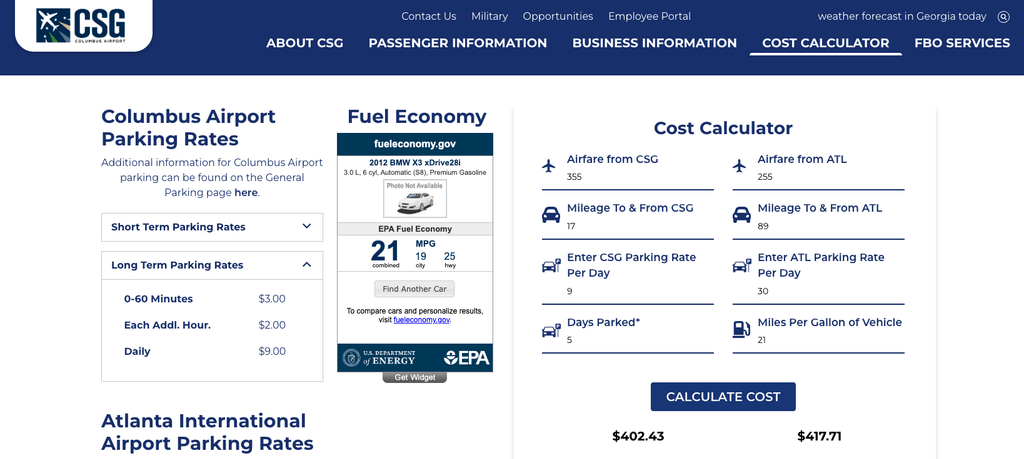
Columbus Airport (CSG) provides a Cost Calculator on its website to help travelers compare the total cost of flying from CSG versus Atlanta (ATL).
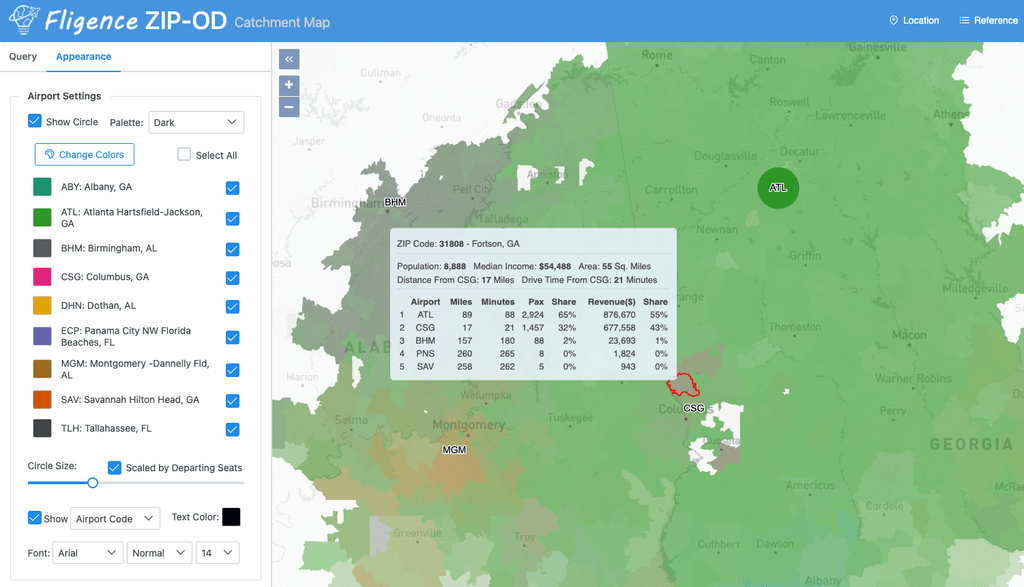
A resident of Fortson, Georgia (see Fig. 1), for example, can enter airfare, driving distance, parking rates at CSG and ATL, number of days parked, and the vehicle’s fuel efficiency. The calculator then estimates the total trip cost for each airport.
In this example, although the airfare from ATL is $100 cheaper than the fare from CSG, the additional driving, fuel, and parking costs make the total cost of using ATL $15 higher. For this traveler, choosing CSG would therefore be both more convenient and less expensive overall.
The comparison could go even further. Travelers who drive to a larger, more distant airport also incur a less visible cost: the value of the additional time spent driving and navigating the airport. Some airports already incorporate the value of travelers’ time into their cost calculators, providing a more complete picture of the true cost of airport choice.
Compete Route by Route, Not Network Against Network
Regional airports do not need to compete equally for every destination. A hub airport will almost always have more destinations than a regional airport. But for a passenger traveling to one particular destination, the comparison is much narrower. If the regional airport provides a convenient nonstop flight to that destination, the hub’s other 100 destinations may not matter.
This creates an important strategic principle:
Regional airports can compete route by route rather than network against network.
The strongest opportunities are often destinations where the regional airport can offer something meaningfully different, such as:
- A nonstop flight that eliminates a connection
- A more convenient schedule
- A competitive fare
- A strong leisure destination
- Service from an airline with significant local demand
This shifts the strategic question from:
“How do we compete with the hub overall?”
to:
“For which destinations can we provide a compelling alternative to the hub?”
A nearby hub is not only a competitor. It can also help reveal the size of the regional airport’s underlying market. If large numbers of residents are driving to the hub to reach a specific destination, that demand already exists. The regional airport does not need to create a new market from nothing. The question becomes:
Could better local air service capture some of the passengers who are currently using the hub?
Suppose residents within the broader market generate 90 PDEW to Orlando, but only 15 PDEW currently use the regional airport. The remaining demand is distributed through surrounding airports.
That does not automatically mean the regional airport can support a nonstop route, but it identifies a market worth evaluating. The Air Service Development team can investigate:
- Where those passengers live
- Which competing airports they use
- Which airlines carry them
- Whether they currently fly nonstop or connect
- What fares they pay
- How concentrated the demand is geographically
- Whether a local nonstop could change passenger behavior
This can also strengthen airline discussions. Rather than presenting only population and economic statistics, the regional airport can demonstrate:
- Passengers from our market are already traveling to this destination.
- They are currently driving to another airport to do it.
That provides evidence of existing travel behavior and the potential to recapture some of that demand with improved local service.
Understand Where the Airport Can Compete Geographically
Not all passengers within a catchment are equally likely to use the regional airport. Some ZIP codes may generate a high share of the airport’s passengers and show strong local airport usage. These communities form the airport’s core geographic market.
Protecting this market can be just as important as trying to expand farther into the hub’s territory. If the airport begins losing share within communities close to the airport, that may deserve more immediate attention than very high leakage from distant communities naturally oriented toward the hub.
Airport teams can monitor:
- Passenger volume by ZIP code
- Airport market share
- Changes in passenger distribution
- Route-specific passenger behavior
- Changes after service additions or reductions
Between the regional airport’s core market and the hub’s strongest territory is often a large competitive zone. For example, a ZIP code may have:
- 40% of passengers using the regional airport
- 45% using the hub
- 15% using other airports
This is very different from a community where the hub already captures 90% of demand. The first ZIP code demonstrates that travelers already consider both airports realistic options. If the regional airport improves service to an important destination, that market may be more responsive than an area where the airport has almost no existing presence.
This suggests a useful way to think about the airport’s geography:
- Core market: Protect it.
- Competitive market: Fight for it.
- Hub-dominated market: Be selective about pursuing it.
PVD and BOS: Competing in the Middle Ground
Rhode Island T.F. Green International Airport (PVD) faces this type of competitive dynamic. Many travelers in Rhode Island and southeastern Massachusetts can reasonably choose between PVD and Boston Logan International Airport (BOS).
For these travelers, airport choice may depend on the destination, available schedules, airfares, and the additional ground travel required to reach Boston. The result is an overlapping airport market rather than a simple geographic boundary between PVD and BOS (see Fig. 3).
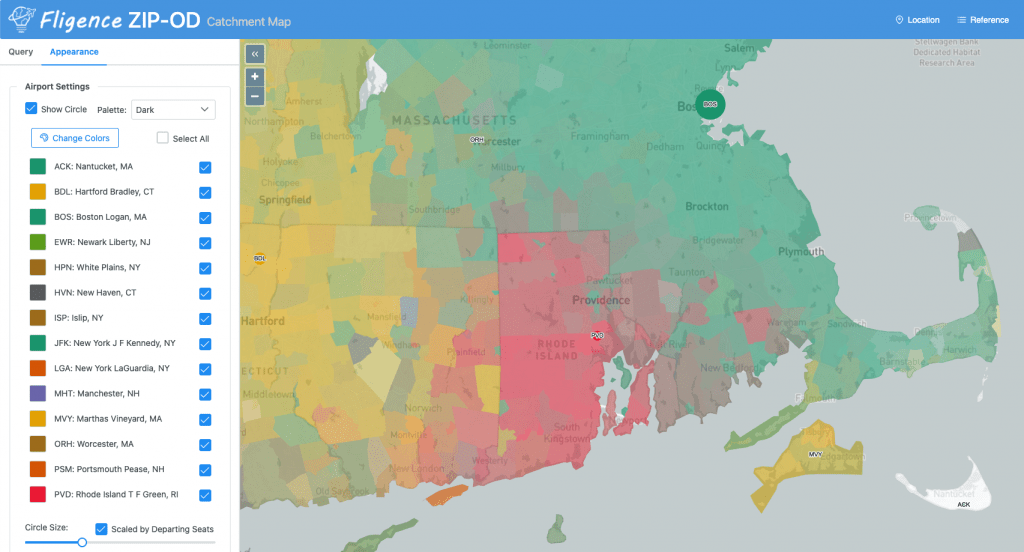
A regional airport such as PVD can compete by strengthening its position in communities where travelers already consider both airports viable options and by developing air service that reduces the need to travel to a larger hub.
PVD has demonstrated that a regional airport can compete on more than network size. While BOS offers a much broader range of nonstop destinations, PVD differentiates itself through convenience, accessibility, and passenger experience. These advantages have earned national recognition: Travel + Leisure readers ranked PVD the #1 airport in the United States in both 2025 and 2026. As a result, market share of PVD for the border area between PVD and BOS has increased from about 14% in the first half of 2023 to about 21% in the first half of 2026, as shown in Fig. 4 below.
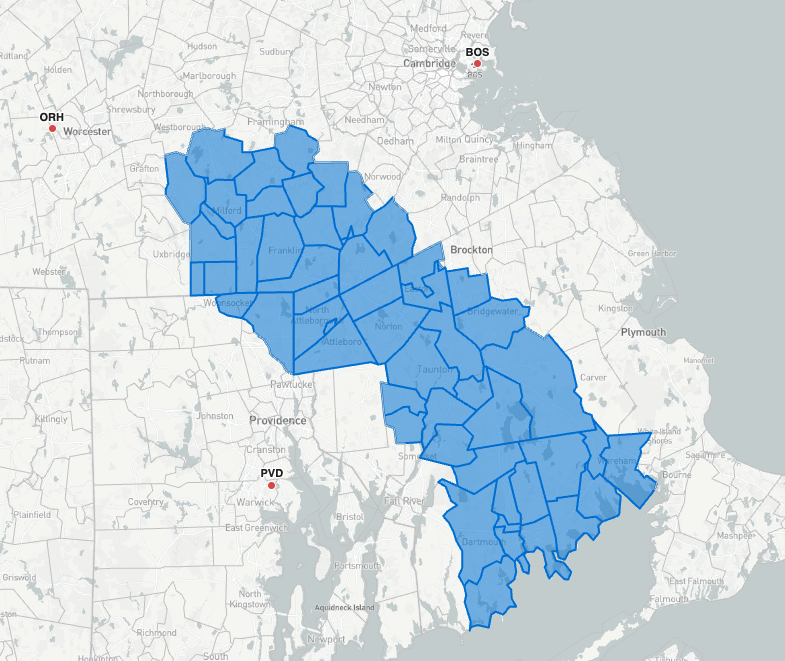
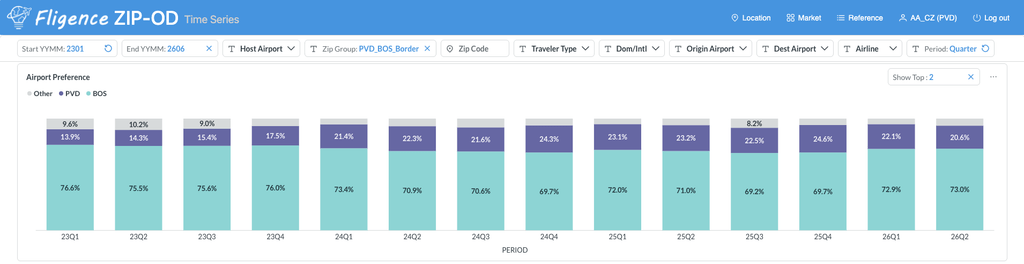
This illustrates why competitive ZIP codes can be particularly important. A regional airport does not need to capture the entire hub market to improve its position. Gaining share within communities where both airports are already viable choices can produce meaningful results.
Build Airline Business Cases Around Addressable Demand
Airlines generally need more than a large leakage number. A stronger regional-airport business case identifies the portion of demand that may realistically shift to local service. For example:
- Total regional demand to destination: 120 PDEW
- Currently using local airport: 25 PDEW
- Currently using nearby hub: 70 PDEW
- Other airports: 25 PDEW
The airport should not automatically claim that all 95 passengers using other airports are recoverable. Instead, the analysis can examine:
- Passenger proximity to the regional airport
- Current nonstop availability
- Fare differences
- Passenger distribution
- Airline preference
- Proposed frequency
- Expected stimulation from new service
This produces a more credible estimate of addressable demand. Airlines are likely to find that more useful than an argument based only on total catchment population.
Service Quality Matters: Nonstop, Fare, Frequency and Schedule
Having a route does not automatically make the regional airport competitive. The quality of the service matters.
Fare
Convenience alone may not overcome a large fare difference. If a regional airport’s fare is consistently much higher than surrounding alternatives, some passengers will continue driving to the hub.
Airports should therefore monitor fare competitiveness by destination rather than relying only on an overall average fare. For each major market, Air Service Development teams can compare the local airport average fare with the weighted average fare available from competing airports and examine the corresponding passenger demand.
This can reveal markets where the regional airport has:
- Strong service but a significant fare disadvantage
- Competitive fares but low passenger share
- A meaningful fare advantage
- Large demand but limited local service
Frequency and Schedule
Adding a nonstop route is valuable, but schedule quality also plays an important role in how useful the service is to travelers. A regional airport offering two midday flights per week may still lose passengers to a nearby hub that offers daily early-morning departures.
Frequency matters because passengers value:
- Choice of departure time
- Choice of return time
- Greater flexibility
- Better connecting opportunities
- Alternatives when travel plans change
This is especially important for business markets. The competitive question should therefore not simply be:
“Do we serve this destination?”
It should be:
“Is our service good enough to change where passengers choose to begin their trip?”
Airport Infrastructure Can Change the Competitive Position
A regional airport’s market position is not determined by geography alone. Travelers may use a larger hub because the local airport does not yet have the facilities, airlines, destinations, or frequencies necessary to be a practical alternative. Improvements to airport infrastructure can therefore affect the airport’s ability to retain local demand.
Provo Airport vs. Salt Lake City
Provo Airport (PVU) provides a strong example of how a regional airport can invest in its own infrastructure and passenger experience to become a more viable alternative to a nearby hub. Located in rapidly growing Utah County, PVU competes with Salt Lake City International Airport (SLC) for travelers who might otherwise drive north to access a much larger network of flights.
For years, PVU’s ability to compete was constrained by its terminal. In its 2021 annual report, Provo Airport stated that the former facility offered little room for growth and deterred airlines from serving the growing market. In response, Provo City, Utah County, the State of Utah, and the FAA supported development of a new terminal, which opened in July 2022 with four gates and the ability to accommodate multiple narrow-body aircraft simultaneously.
The investment helped create the conditions for substantial air service growth. As shown in Fig. 5, PVU’s enplanements recovered to pre-COVID level in 2021 and then increased from 212,121 in 2022 to 532,776 in 2025, more than doubling in three years.
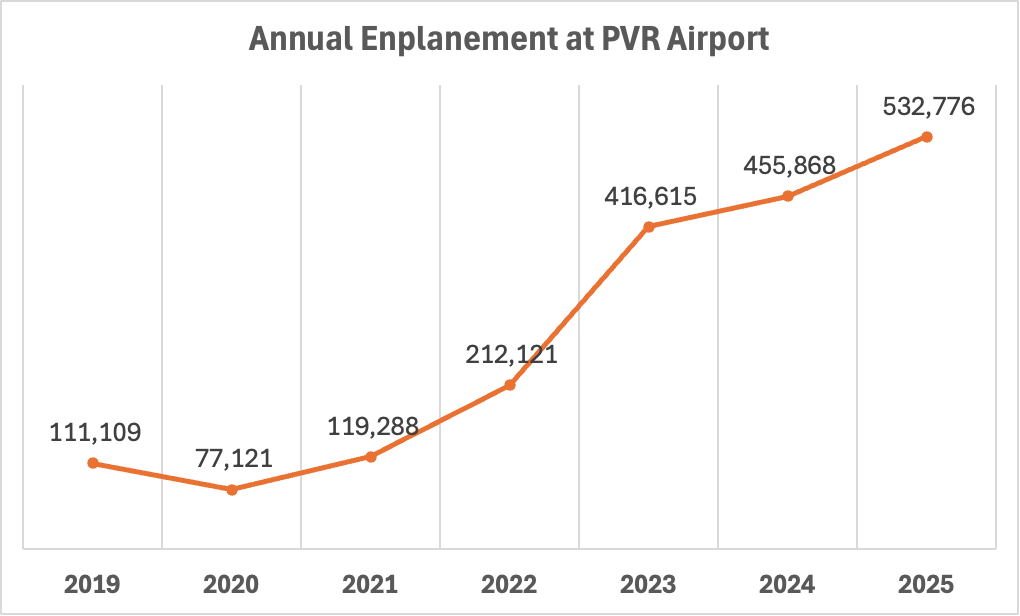
Rather than stopping there, the airport is investing again. PVU has begun another major expansion that will ultimately increase the terminal from four to ten gates, along with expanded ticketing, baggage facilities and infrastructure intended to support international service.
For regional airports, PVU illustrates an important point: airport market share is not determined by geography alone. Travelers may use a larger hub because the local airport lacks the facilities or air service necessary to be a practical alternative. Investments that enable additional airlines, destinations and frequencies can make the regional airport more competitive and give local passengers a reason to stop driving to the larger hub.
Catchment analysis can help quantify this opportunity by identifying communities where large numbers of passengers currently use the hub despite living significantly closer to the regional airport. As local service improves, changes in airport share at the ZIP-code level can then show whether the regional airport is successfully recapturing demand from its own market.
Target Marketing Where It Can Change Behavior
Marketing should not necessarily be distributed evenly throughout the entire catchment. A regional airport may gain more from focusing on communities where:
- Air travel demand is high
- The airport already has some meaningful share
- Passenger leakage is substantial
- Residents have reasonable access to the airport
- Relevant local nonstop service exists
Suppose two ZIP codes each contain 20,000 leaked passenger trips. One is 20 minutes from the regional airport and has strong local service to the destinations residents travel to. The other is 1.5 hours away and closer to the hub. The first market may be far more addressable. Marketing resources can therefore be concentrated where the regional airport has a credible product to promote.
Use New Routes for Highly Targeted Marketing
New nonstop service creates one of the best opportunities for targeted airport marketing. Rather than promoting a new route throughout the entire region, airports can identify:
- Where passengers currently traveling to that destination live
- Which ZIP codes generate the most demand
- Where those passengers currently access air service
A campaign can then focus on the communities with the greatest relevant passenger volume. This connects Air Service Development and Marketing directly:
- ASD identifies the route opportunity.
- Passenger-location analysis identifies the audience.
- Marketing communicates the new local option to those passengers.
Track Whether the Strategy Is Working
Regional airports should measure changes in passenger behavior rather than relying only on total enplanements.
Useful measures include:
- Airport market share by ZIP code
- Passenger retention by destination
- Passenger volume from target communities
- PDEW before and after new service
- Changes in competing-airport usage
- Passenger distribution by drive time
If a new route begins and the airport’s share increases in the ZIP codes generating the most demand for that destination, that provides evidence that the service is changing local behavior.
Similarly, targeted marketing can be evaluated by monitoring whether passenger share improves in the geographic areas receiving the campaign. This creates a feedback loop:
Identify opportunity → Improve service or marketing → Measure passenger response → Refine the strategy
Use Fligence to Identify Where a Regional Airport Can Compete
FlightBI’s Fligence platform allows regional airports to analyze their market at a more detailed geographic and destination level.
Airport teams can use Fligence to examine:
- Where resident passengers live
- Which ZIP codes generate the most air travel demand
- Airport market share by ZIP code
- Which airports are capturing local passengers
- Destination-level PDEW
- Average fares compared with competing airports
- Passenger distribution for specific routes
Together, these analyses can help regional airports distinguish between demand that is unlikely to shift and markets where improved service or marketing may realistically influence airport choice.
Instead of trying to compete everywhere, the airport can identify where it has the strongest opportunity to win.
The Bottom Line
A regional airport usually cannot compete with a nearby hub by offering the same number of airlines, frequencies, and destinations. It does not need to.
The more effective strategy is to compete selectively by offering a better total travel experience for specific passengers and specific markets.
That means:
- Making the total convenience of using the local airport measurable
- Protecting the airport’s core geographic market
- Competing for communities where travelers already consider both airports
- Identifying high-demand destinations where local service can provide a meaningful alternative
- Building airline cases around addressable rather than theoretical demand
- Maintaining competitive fares, frequencies, and schedules
- Targeting marketing where passenger behavior can realistically change
- Measuring whether new service and marketing actually recapture passengers
A nearby hub will always attract some passengers. The strategic question for the regional airport is not:
“How can we stop everyone from using the hub?”
It is:
“For which passengers, communities, and destinations can our airport provide the better choice?”