
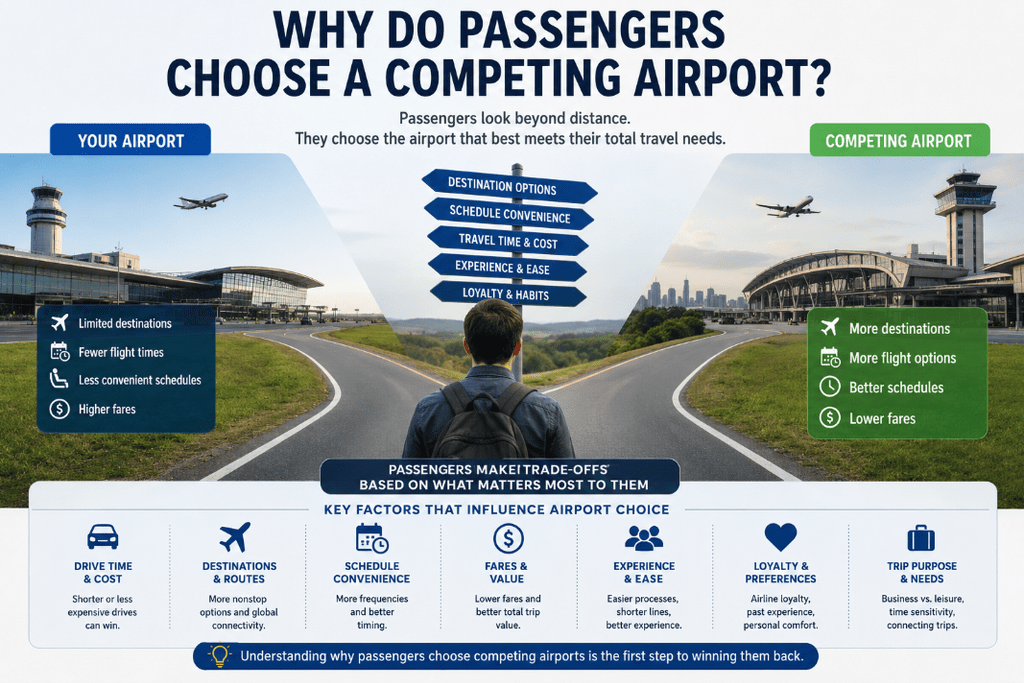
Passengers choose a competing airport when they believe it offers a better overall travel option than their local airport. The decision is usually based on a combination of airfare, nonstop service, flight schedule, airport accessibility, airline preference, and the passenger’s specific trip.
The closest airport does not always win. A traveler may drive farther for a nonstop flight, a substantially lower fare, a better departure time, or access to an airline or destination unavailable locally. Another traveler may pay a higher fare to avoid a long drive and use the airport closest to home.
For airport Air Service Development and Marketing teams, understanding these tradeoffs is important because passenger leakage does not have one universal cause. Different passengers—and different destination markets—can have very different reasons for choosing another airport.
1. Nonstop Service
One of the strongest reasons passengers may choose another airport is access to a nonstop flight.
Consider two options:
- Local Airport: 25-minute drive + connecting flight
- Competing Airport: 75-minute drive + nonstop flight
The competing airport requires an additional 50 minutes of driving, but the nonstop flight may eliminate several hours of total travel time. It also removes the inconvenience and uncertainty of making a connection.
The value of nonstop service can be particularly important for:
- Business travel
- Family travel
- International trips
- Short-duration trips
- Destinations with inconvenient connections
- Travelers carrying significant luggage
A nearby airport may therefore lose passengers to a more distant airport when the difference in air service is substantial.
2. Airfare
Price can also motivate passengers to travel farther.
Suppose a traveler can purchase a round-trip ticket for:
- Local Airport: $525
- Competing Airport: $325
A $200 difference may be enough to justify additional driving. For a family of four, that difference becomes $800, making the competing airport even more attractive.
But fare sensitivity varies by traveler. A business traveler may value time more than a $100 fare difference, while a leisure traveler may be willing to drive significantly farther to save the same amount. This is why fare differences should be evaluated together with passenger type, drive time, and available service.
3. Flight Frequency
Two airports may both offer nonstop service to the same destination but provide very different schedules.
For example:
- Local Airport: 1 flight per day
- Competing Airport: 5 flights per day
The competing airport gives passengers more choices.
A traveler may find a departure time that better fits the trip, avoid an extra hotel night, or have more alternatives if a flight is delayed or canceled. For business travelers in particular, frequency can be nearly as important as whether nonstop service exists at all.
From a passenger’s perspective, the question is often not simply:
“Does my airport fly there?”
but:
“Does my airport offer a flight that works for my schedule?”
4. Better Departure and Arrival Times
Even when frequency is similar, schedule timing can influence airport choice.
Consider an overnight business trip.
The local airport offers:
Departure: 2:30 PM
while a competing airport offers:
Departure: 7:00 AM
The early flight may allow the traveler to conduct a full day of business at the destination. On the return, a late-evening flight may allow the traveler to avoid an additional hotel night. The competing airport can therefore offer a more useful itinerary even if the fare and total number of flights are similar.
Air Service Development teams should consider not only whether service exists, but also how usable the schedule is for the passengers the route is intended to serve.
5. Access to More Destinations
Larger airports generally provide access to more nonstop destinations. For passengers living between a small regional airport and a large hub, this can create a strong reason to bypass the local airport.
A passenger may regularly use the local airport for destinations it serves well but choose the larger airport for trips requiring destinations or schedules unavailable locally.
This means passenger loyalty to an airport is not absolute. The same person might use:
- the local airport for Orlando,
- a larger regional airport for Los Angeles,
- and
- a major international gateway for Seoul.
Airport choice is often trip-specific rather than passenger-specific.
6. Airline Preference and Loyalty Programs
Some passengers prefer a particular airline because of:
- Frequent-flyer status
- Miles or points
- Credit-card benefits
- Lounge access
- Corporate travel agreements
- Upgrade eligibility
- Familiarity with the airline
- Network connectivity
If the preferred airline has a much larger presence at another airport, passengers may travel farther to use it. A frequent United Airlines traveler, for example, may place greater value on access to a United hub than a traveler without airline status. This factor can be particularly important among frequent and premium travelers.
7. Better Connecting Options
Nonstop service is not the only airline-network consideration. When a nonstop flight is unavailable, passengers may choose an airport based on the quality of the available connection.
One airport might provide:
one connection + 5 hours total travel time
while another provides:
one connection + 8 hours total travel time
Even though both itineraries technically involve one stop, they are not equivalent from the passenger’s perspective.
The connecting hub, layover duration, schedule, and number of itinerary options can all affect airport choice. For international destinations in particular, access to a strong airline hub can substantially change the attractiveness of an airport.
8. Drive Time and Ground Accessibility
While passengers may drive farther for better air service, airport accessibility still matters. A competing airport may actually be easier to reach even if it is farther away in straight-line distance. Highway access, congestion, bridges, tolls, public transportation, parking access, and road reliability can all influence the ground portion of the journey.
For example:
- Airport A: 35 miles away but 70 minutes in congestion
- Airport B: 55 miles away but 60 minutes primarily by interstate
Airport B is geographically farther but may be easier to access.
This is why airport choice models should consider actual travel time and accessibility rather than distance alone.
9. Parking and Ground-Travel Costs
Passengers evaluate more than airfare. Parking prices, tolls, fuel, rideshare costs, rental cars, and public transportation can affect the total cost of using an airport.
Suppose a competing airport offers a ticket that is $75 cheaper but requires:
- $40 more in parking
- $15 in tolls
- additional fuel
The apparent airfare advantage becomes much smaller.
Conversely, inexpensive parking at a regional airport can partially offset a higher airfare. For this reason, passengers may implicitly evaluate the total trip cost, not just the airline ticket.
10. Airport Convenience and Passenger Experience
Airport experience can also influence choice, especially when the differences in fare and service are relatively small.
Passengers may value:
- Short security lines
- Easy parking
- Short walking distances
- Less congestion
- Familiarity with the terminal
- Faster baggage claim
- Easy pickup and drop-off
- Smaller crowds
- Convenient rental-car facilities
These factors can be an important advantage for smaller airports. A regional airport may not be able to match the route network of a major hub, but it may provide a much easier beginning and end to the passenger journey. The key is whether that convenience provides enough value to offset differences in airfare or air service.
11. International Service Can Change Passenger Behavior
International trips can produce very different airport-choice patterns from domestic travel.
Passengers may travel several hours to reach an airport offering:
- Nonstop international service
- More international destinations
- Better one-stop connections
- An airline serving their destination region
- More competitive international fares
This can make a distant international gateway an important competitor even when relatively few passengers use that airport for domestic travel.
Punta Gorda Airport’s leakage study provides a good example. Within PGD’s study area, Miami International Airport (MIA) accounted for only about 1% of domestic passenger traffic, but approximately 47.8% of international traffic. The airport did not become geographically closer for international trips. The value of the service available at MIA changed the passenger’s airport-choice equation.
12. Destination and Community Characteristics Matter
Airport-choice behavior can also reflect the characteristics of the destination and the communities generating the travel. For international routes, cultural and family connections can create geographic concentrations of demand.
For example, the Washington, D.C. region has significant Korean communities in areas such as Centreville and Annandale, Virginia. For travel to South Korea, an airport may therefore see a higher concentration of passengers originating from these communities than it sees in its overall passenger distribution.
This means the factors driving airport choice for a particular route may be tied not only to airline service but also to who is traveling and why they are traveling.
Real-World Example: Manchester-Boston and Boston Logan
Manchester-Boston Regional Airport (MHT) illustrates the competitive challenge regional airports can face when located near a major airport. MHT is about 50 miles from Boston, placing many travelers within reach of both Manchester and Boston Logan International Airport (BOS). Manchester has publicly identified increased low-cost-carrier competition at Logan as one of the challenges affecting its passenger market.
For travelers evaluating the two airports, the decision may involve several tradeoffs. Manchester can offer the convenience of a smaller airport, while Logan provides a much larger selection of airlines, destinations, and frequencies.
The result is not that every traveler automatically chooses one airport. Instead, the preferred airport can change depending on the trip. A passenger may use MHT when its service fits the itinerary and BOS when the larger airport provides a significantly better flight option.
Real-World Example: Hagerstown and the Washington-Baltimore Airport System
Hagerstown Regional Airport (HGR) provides an even more pronounced example. Travelers in Hagerstown’s broader market can access several major airports, including BWI, Washington Dulles, and Reagan National.
A 2023 catchment study estimated that those three airports captured the large majority of domestic airline trips generated within HGR’s 44-ZIP-code immediate catchment.
Why would passengers drive that far? The answer is unlikely to be one factor. The Washington-Baltimore airports collectively provide substantially greater airline capacity, destination options, frequency, and connectivity.
For HGR, understanding passenger behavior therefore requires examining what travelers gain by making the longer ground trip. That is ultimately the central question behind passenger leakage.
Different Passengers Value the Factors Differently
There is no universal formula that applies equally to every traveler. Consider three passengers choosing between the same two airports.
- Business traveler: May prioritize nonstop service, schedule, frequency, and total travel time.
- Leisure traveler: May place greater weight on airfare and be more willing to drive farther.
- Family of four: May be especially sensitive to airfare because every fare difference is multiplied across four tickets.
- International traveler: May be willing to travel much farther to obtain a nonstop flight than someone taking a short domestic trip.
Airport-choice analysis therefore becomes more useful when it recognizes that passengers have different sensitivities and priorities.
Which Factors Can Airports Influence?
Not every cause of passenger leakage is equally actionable. An airport generally cannot change:
- Its physical location
- The location of competing airports
- Where major population centers are located
But airports and their airline partners may be able to influence:
- Available nonstop service
- Flight frequency
- Schedule quality
- Fare competitiveness
- Airline awareness
- Parking and airport convenience
- Marketing awareness
- Passenger perception of the airport
This distinction is important. The goal of understanding why passengers use another airport is not simply to explain leakage. It is to identify the factors where changes could realistically affect passenger behavior.
How Can Airports Determine Why Their Passengers Are Leaving?
No single dataset can explain every passenger’s decision. Instead, airports can combine several types of evidence.
- Passenger-location data shows where travelers live.
- Leakage analysis shows which airports they use.
- Fare comparison shows whether passengers may face a price advantage elsewhere.
- PDEW and destination analysis show where passenger demand is concentrated.
- Airline schedule data shows differences in nonstop service, frequency, and connectivity.
- Passenger surveys can provide direct information about traveler preferences and motivations.
When these sources point in the same direction, the likely explanation becomes much stronger.
For example:
- High leakage + substantially lower competitor fare suggests a potential fare issue.
- High leakage + competitor nonstop service + no local nonstop suggests a service issue.
- Competitive fare + comparable service + high leakage in distant ZIP codes may point more strongly toward geographic accessibility.
Rather than assigning one explanation to all leakage, airports can diagnose the likely cause market by market.
Using Fligence to Investigate Airport Choice
FlightBI’s Fligence platform allows airport teams to examine several dimensions of passenger behavior together.
The Pax Location and Leakage Dashboards can identify where passengers live and which airports they use.
The Fare Comparison Dashboard can compare the target airport’s average fare with the weighted average fare available through competing airports and compare PDEW across major destinations.
The Catchment Map can show how the geographic pattern changes by market.
Together, these tools help airport teams move from:
“Passengers are using another airport.”
to:
“What characteristics of this market may be influencing their decision?”
That distinction is important because different causes require different responses.
The Bottom Line
Passengers choose competing airports because they are evaluating the overall value of the trip, not simply the distance to the terminal.
Their decision may reflect: nonstop service, airfare, frequency, schedule, airline preference, connectivity, ground accessibility, total trip cost, and airport convenience.
The importance of each factor changes by passenger and destination. For airport teams, the most useful question is therefore not simply:
“Why are passengers leaking?”
It is:
“For this specific market, what advantage is the competing airport providing that is strong enough to change passenger behavior?”
Once that advantage is understood, Air Service Development and Marketing teams can determine whether it is something the airport can realistically address.