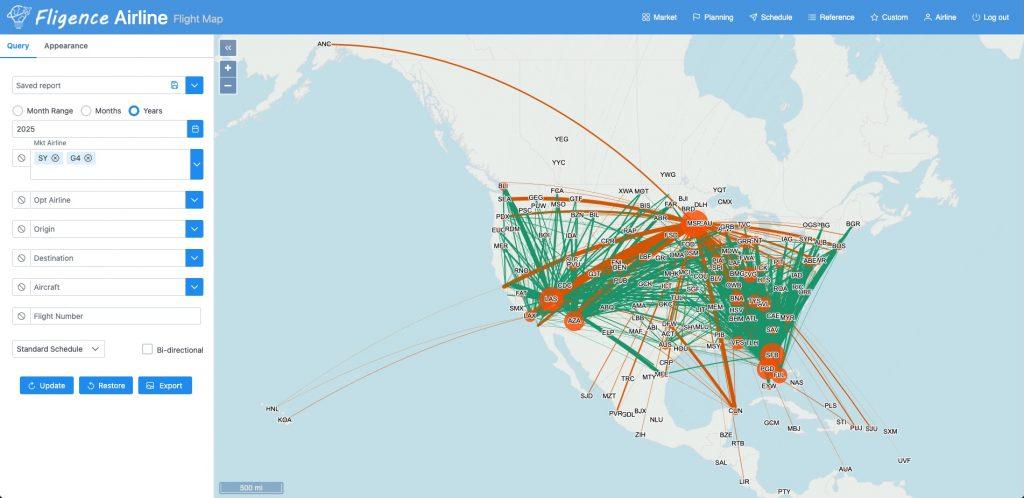
With Allegiant Air announcing a $1.5B merger with Sun Country Airlines, the combined route map tells a powerful story.
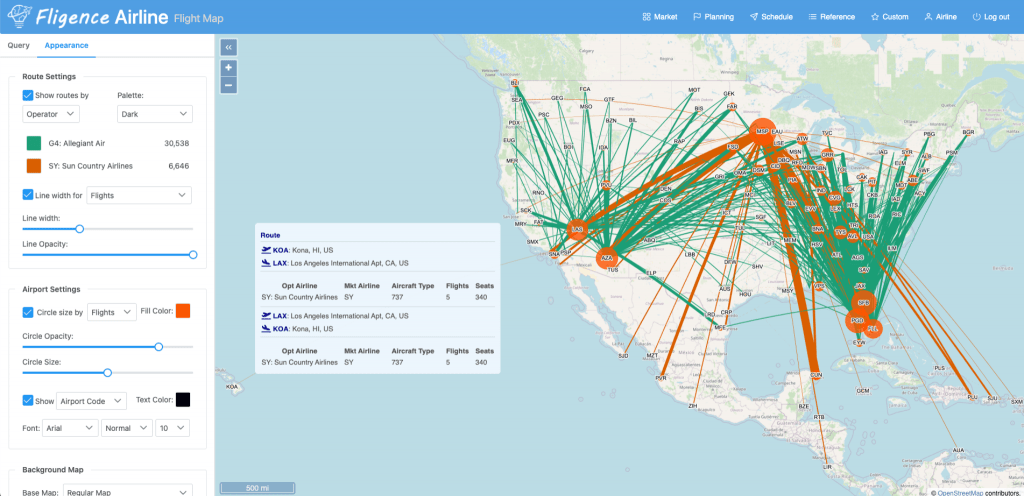
Using January–March 2016 schedules, this merged network highlights how complementary—not overlapping— these two airlines really are:
🔹 Allegiant
• Strong point-to-point leisure focus
• Deep coverage of small and mid-size U.S. markets
• Heavy connectivity to Florida, the Southwest, and secondary airports
🔹 Sun Country
• MSP-centric network with broader Midwest reach
• Longer-haul leisure routes, including Hawaii and major coastal cities
• Higher aircraft utilization on denser city pairs
Why this combination works
- Minimal route overlap → limited cannibalization
- Expanded national leisure footprint without major hub conflicts
- Strong balance between ultra-low-frequency leisure flying and higher-density seasonal routes
- Greater flexibility to optimize aircraft deployment and grow underserved markets
Visually, the merged map shows a dense web of leisure connectivity across the U.S., anchored by MSP, Florida, and the Southwest—positioning the combined airline as a scaled leisure powerhouse rather than a traditional hub-and-spoke carrier.
This is a reminder that in airline M&A, network fit matters more than size alone.
Curious to hear thoughts from others in air service development and network planning—what markets do you think benefit most from this combination?